Introduction
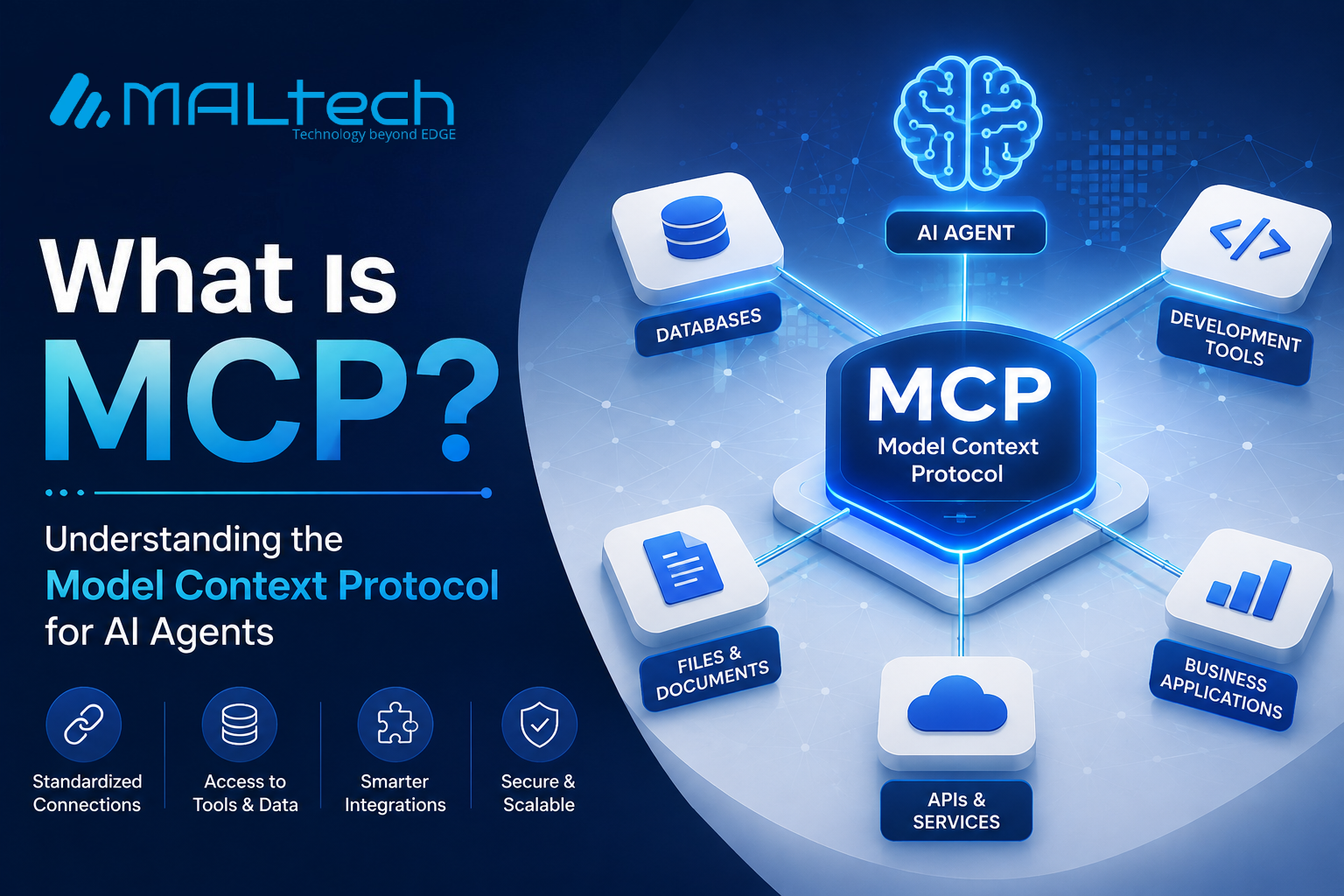
AI systems are becoming more capable every day. They can understand information, generate content, write code, analyze data, and increasingly take actions on behalf of users. But there is a practical problem: an AI model cannot automatically access every tool, application, database, or business system it may need. This is where Model Context Protocol (MCP) comes in. MCP provides a standardized way for AI applications to connect with external tools and sources of information. Instead of building a separate connection for every AI application and every tool, MCP provides a common framework for these interactions.
For businesses exploring AI agents and automation, understanding MCP is becoming increasingly important because better connectivity can make AI systems more useful, flexible, and easier to integrate.
What Is Model Context Protocol (MCP)?
Model Context Protocol (MCP) is a standardized protocol that allows AI applications to connect with external tools, data sources, and services. In simple terms, think of MCP as a common language between an AI application and the systems it needs to interact with. An AI model may be able to reason about a task, but it may need access to a database, a file, a search system, or another application to actually complete that task. MCP provides a structured way for these connections to happen. Instead of creating a custom integration every time an AI application needs to interact with a new system, developers can use MCP to establish a more standardized connection.
Why Do AI Agents Need MCP?
AI agents become much more useful when they can do more than generate responses. For example, an AI agent working for a business might need to: Understand a request → Search company data → Check a database → Use an external tool → Take an action → Return the result Without a standardized approach, developers may need to create and maintain individual integrations between the AI application and each system. As the number of tools increases, this can become difficult to manage.
MCP helps address this connectivity challenge by providing a common framework for AI applications to interact with external capabilities. This makes it easier to think about AI not just as a model that generates text, but as a system that can interact with the environment around it.
How Does MCP Work?
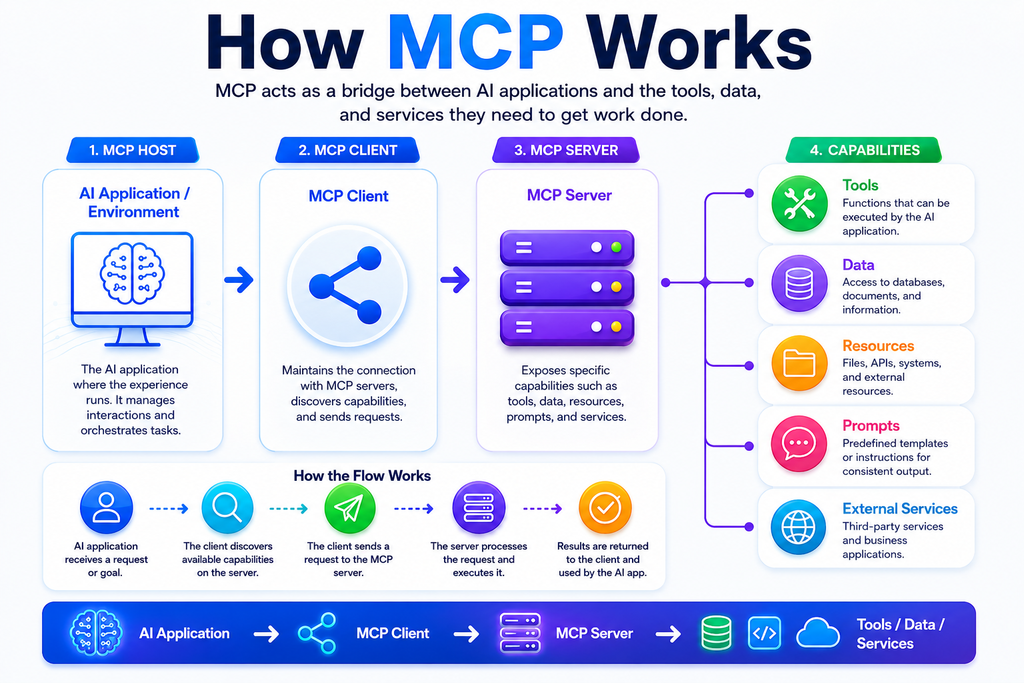
At a high level, MCP uses a client-server architecture.
MCP Host
The host is the AI application or environment where the AI experience runs. It manages the interaction between the AI model and MCP-connected systems.
MCP Client
The client maintains the connection between the host application and an MCP server. It allows the AI application to discover and interact with capabilities provided by MCP servers.
MCP Server
An MCP server exposes specific capabilities that an AI application can use. These capabilities can include access to:
- Tools
- Data
- Resources
- Prompts
- External services
The basic flow can be understood as:
AI Application → MCP Client → MCP Server → Tool / Data / Service
The AI can then use the information or capability provided through that connection as part of completing a task.
MCP vs Traditional AI Integrations
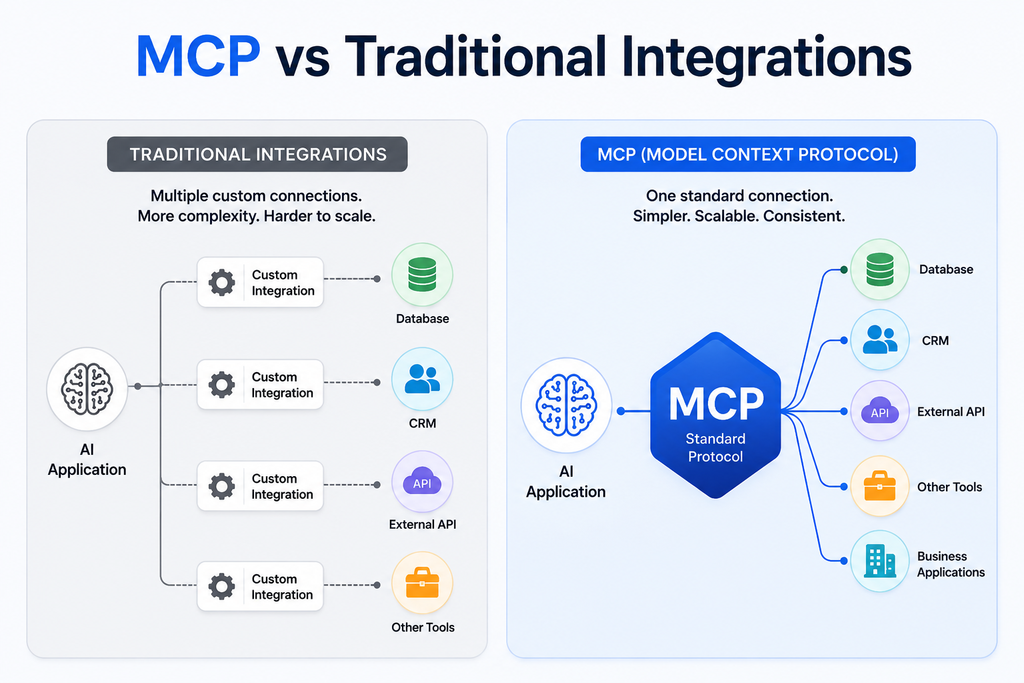
Before standardized protocols such as MCP, developers often had to create individual integrations between an AI application and different tools.
For example:
AI Model → Custom Integration → Database AI Model → Custom Integration → CRM AI Model → Custom Integration → Search AI Model → Custom Integration → Business Application
As the number of systems increases, maintaining these individual connections can become complicated. With MCP, the goal is to introduce a more consistent way for AI applications to communicate with external systems. This doesn’t eliminate the need for integration work. Instead, it provides a standardized structure for building and managing those connections.
MCP and AI Agents
This is where MCP becomes particularly interesting. An AI agent may have the ability to reason about a goal, but reasoning alone isn’t enough to complete many real-world tasks. Consider a sales assistant. The agent might need to: Understand the request → Search the CRM → Review customer information → Check previous interactions → Prepare a response → Update the CRM. Each step may involve a different system. In this situation, MCP can provide the connections that allow the AI application to access the tools and information required during the workflow. In this sense: AI Agents provide the intelligence and decision-making. MCP provides a standardized way to connect that intelligence with external capabilities. MCP is therefore not an AI agent itself. It is a protocol that helps AI applications interact with the tools and context they need.
Real-World Business Use Cases
MCP can be useful across different business workflows.
Customer Support – An AI agent could access customer records, order information, support documentation, and other business systems to help resolve customer requests.
Sales An AI system could work with CRM information, customer data, research tools, and communication platforms as part of a sales workflow.
Data Analysis – An AI application could interact with approved data sources to retrieve information and support analysis.
Software Development – AI coding assistants can benefit from access to development tools, repositories, documentation, and other resources.
Business Operations – AI systems can interact with internal applications and data sources to support repetitive workflows and operational tasks. The exact implementation depends on the organization’s systems, permissions, security requirements, and business objectives.
Benefits of MCP
Standardized Connectivity – MCP provides a common approach for connecting AI applications with external capabilities.
Reusable Integrations – A standardized interface can make integrations easier to reuse across compatible AI applications.
Simpler AI Tool Access – AI applications can discover and interact with available tools and resources through a consistent structure.
Scalability – As organizations introduce more AI use cases, standardized connectivity can help reduce the complexity of managing integrations.
Better AI Applications – When AI systems can securely access the right information and tools, they can move beyond simple question answering toward more useful workflows.
Security and Governance Still Matter
MCP can make AI-to-system connectivity easier, but connectivity also introduces responsibility. An AI application with access to business systems should not automatically receive unlimited permissions.
Organizations need to consider:
- What data can the AI access?
- Which tools can it use?
- What actions can it perform?
- What permissions should each connection have?
- When should human approval be required?
Therefore, security, authentication, authorization, data privacy, monitoring, and governance should remain part of the overall architecture. Connecting an AI system to more tools does not automatically make it better. The connections must be useful, controlled, and secure.
MCP vs AI Agents: Are They the Same?
No. They solve different parts of the problem. AI Agents focus on understanding goals, reasoning, making decisions, and taking actions. MCP focuses on providing a standardized way for AI applications to connect with tools, resources, and external systems.
A simple way to remember the difference is: AI Agents decide what to do. MCP helps them connect to what they need to do it. This distinction is important when designing practical AI systems.
MALtech Perspective
At MALtech, we see standardized AI connectivity as an important part of building practical and scalable AI solutions.
As businesses move from experimenting with AI models toward deploying AI agents and intelligent workflows, those systems need reliable access to the right tools, information, and business applications. MCP represents an important step toward making those connections more consistent.
However, the protocol itself is only one part of the architecture. The real value comes from combining AI intelligence, reliable data, secure integrations, appropriate permissions, and well-designed business workflows.
Our focus at MALtech is on turning emerging technologies into practical solutions that can create measurable value for businesses.
Conclusion
AI is moving beyond systems that simply generate answers. Modern AI applications increasingly need to access information, use tools, interact with systems, and take meaningful actions. Model Context Protocol (MCP) provides a standardized approach for connecting AI applications with external tools, resources, and data sources. It does not replace AI agents, and it does not make an AI system autonomous by itself. Instead, MCP can provide an important connectivity layer that helps AI applications interact with the capabilities they need.
The simplest way to remember it is: AI Agents provide the intelligence. MCP provides the connection.
As businesses continue to adopt AI agents and intelligent automation, standardized connectivity will become increasingly important for building systems that are useful, scalable, secure, and practical.