Introduction
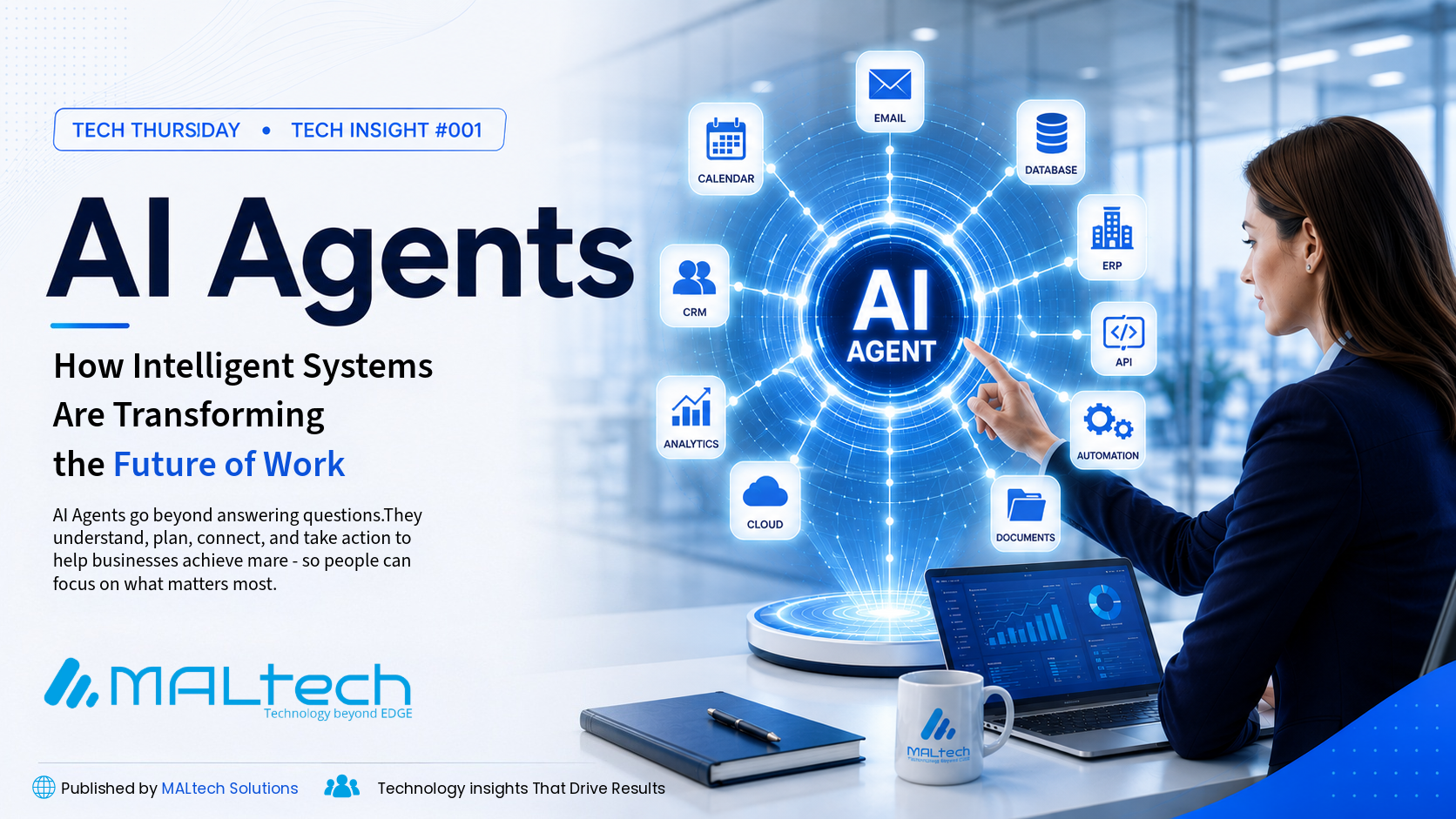
AI agents are changing how businesses automate tasks, make decisions, and manage complex workflows. Unlike traditional software that follows predefined instructions, AI agents can understand goals, reason through problems, use tools, and take actions with greater autonomy.
From customer support and marketing to data analysis and operations, these intelligent systems are helping organizations improve efficiency and create more intelligent workflows. As these systems continue to evolve, they are becoming an important part of the future of work.
Artificial Intelligence is evolving rapidly. While traditional AI tools assist users by answering questions or generating content, these intelligent systems take the next step by understanding goals, making decisions, interacting with business systems, and completing tasks with minimal human intervention.
As organizations continue their digital transformation journey, these systems are emerging as powerful digital teammates that improve productivity, reduce operational costs, and enable employees to focus on strategic and creative work.
What Are AI Agent?
An AI Agent is an intelligent software system capable of understanding objectives, planning actions, interacting with business tools, executing tasks, and continuously improving through feedback. Unlike traditional automation, these intelligent systems can adapt to changing situations, make informed decisions, and work toward achieving business goals with minimal human supervision.
Core Characteristics
- Goal-oriented execution
- Autonomous decision-making
- Context awareness
- Intelligent planning
- Continuous learning
- Integration with enterprise systems
- Collaboration with humans
Think of an AI Agent as a digital employee rather than a digital assistant.
Why AI Agents Matter
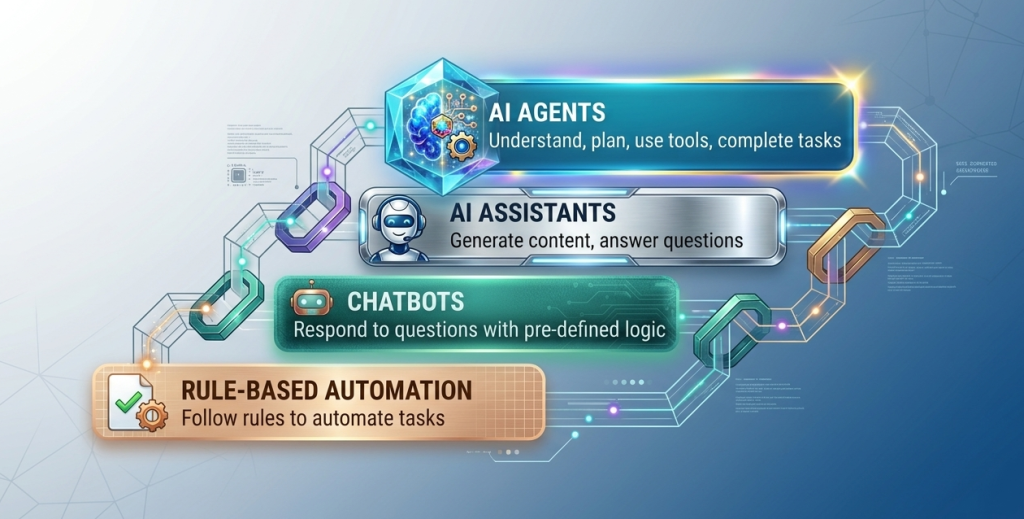
Modern businesses generate enormous amounts of data and rely on numerous software applications to manage daily operations. Employees often spend significant time on repetitive tasks such as:
- Responding to emails
- Updating CRM systems
- Scheduling meetings
- Processing invoices
- Creating reports
- Managing customer requests
Although these tasks are necessary, they consume valuable time that could be spent on innovation and business growth. AI Agents address this challenge by automating repetitive processes while maintaining accuracy, speed, and consistency. Instead of simply assisting users, AI systems actively perform work on behalf of individuals and organizations.
AI Agents vs Traditional Chatbots
Although both technologies use Artificial Intelligence, their capabilities differ significantly.
| Chatbots | AI Agents |
| Respond to questions | Complete business tasks |
| Follow predefined scripts | Plan multiple actions |
| Limited context | Understand business context |
| Require user guidance | Work autonomously |
| Conversation-focused | Outcome-focused |
Example
A chatbot may tell you how to reschedule a meeting. An AI Agent can:
- Check calendars
- Find available time slots
- Reschedule the meeting
- Send updated invitations
- Notify participants
The task is completed without requiring additional user effort.
How AI Agents Work
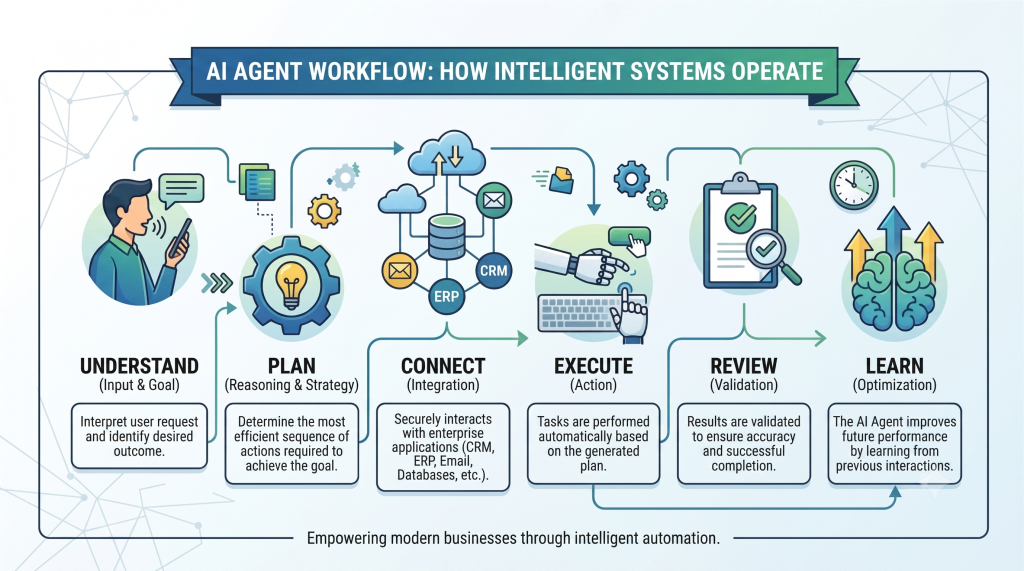
AI Agents operate through an intelligent decision-making workflow.
Step 1 – Understand : The AI Agent interprets the user’s request and identifies the desired outcome.
Step 2 – Plan : It determines the most efficient sequence of actions required to achieve the goal.
Step 3 – Connect : The AI Agent securely interacts with enterprise applications such as:
- CRM
- ERP
- Email platforms
- Databases
- Cloud storage
- APIs
- Business software
Step 4 – Execute : Tasks are performed automatically based on the generated plan.
Step 5 – Review : Results are validated to ensure accuracy and successful completion.
Step 6 – Learn : The AI Agent improves future performance by learning from previous interactions.
AI Agents in Action
Consider a customer support scenario.
Traditional Customer Support Workflow (Without AI Agent)
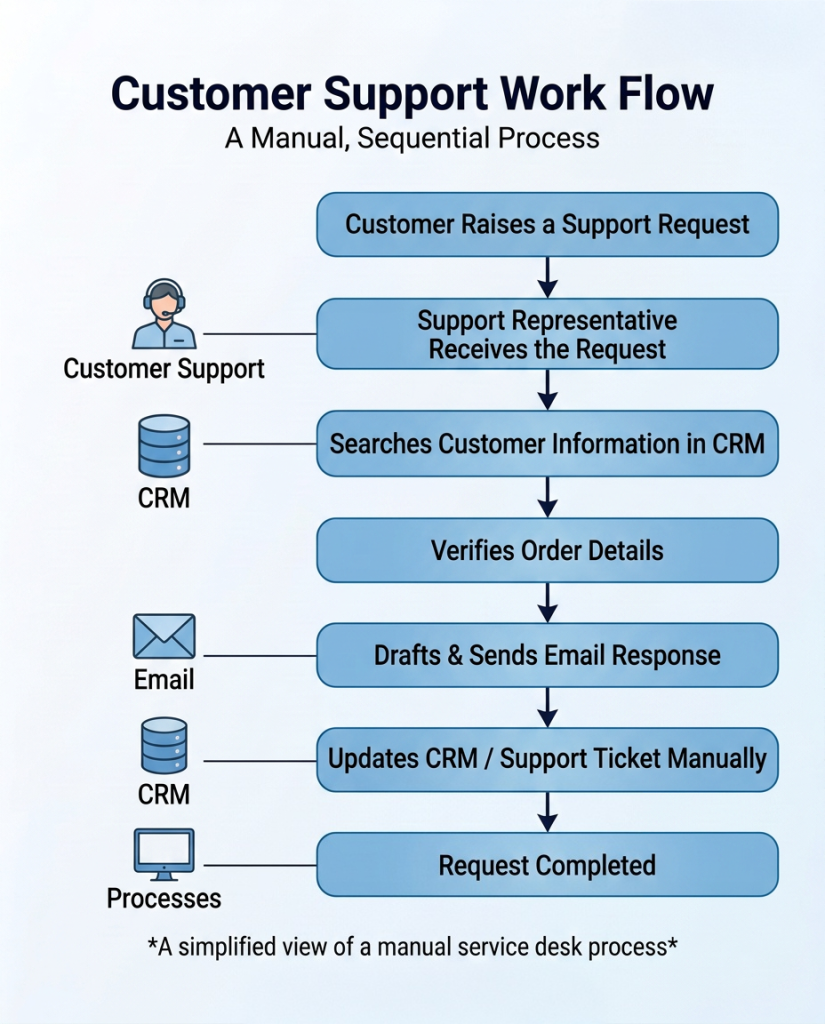
Traditional Customer Support Workflow
Explanation
Every step requires manual effort from a support representative, making the process slower and more resource-intensive.
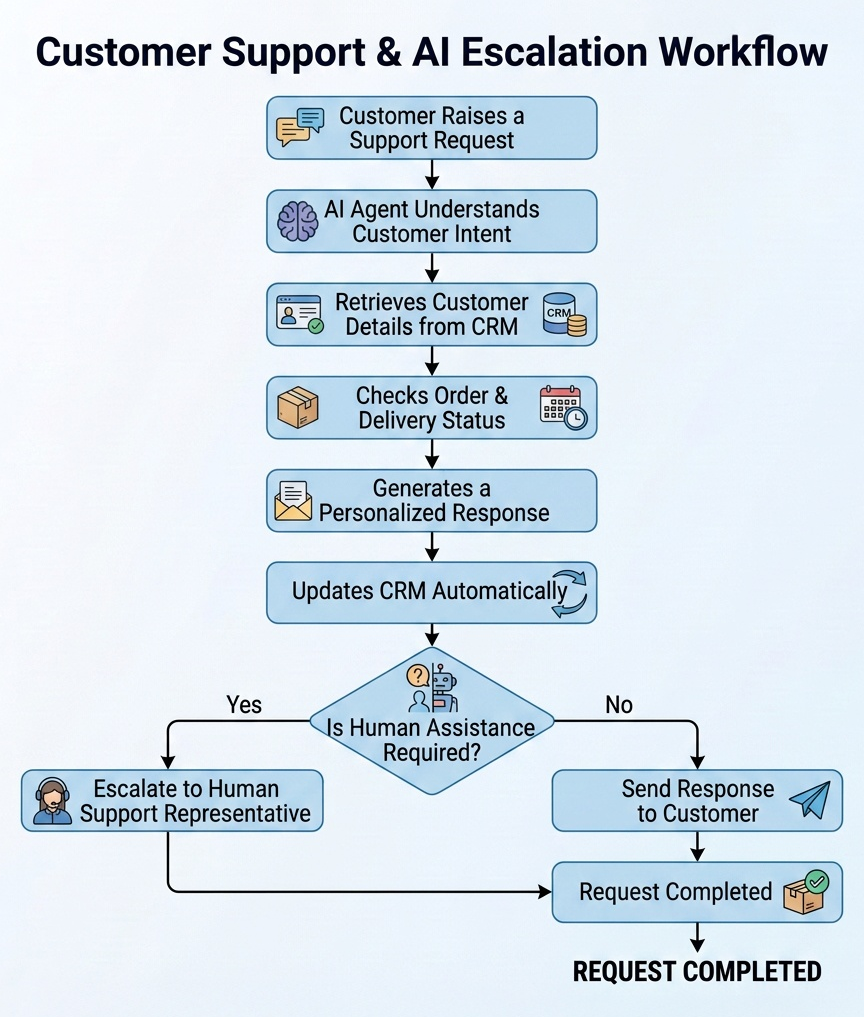
AI Agent Customer Support Workflow
Industry Applications
AI Agents are transforming nearly every business function.
Customer Service
- Ticket management
- Customer support
- FAQ automation
Healthcare
- Appointment scheduling
- Patient communication
- Clinical documentation
Finance
- Invoice processing
- Fraud monitoring
- Financial reporting
Marketing
- Campaign optimization
- Content generation
- Lead nurturing
Human Resources
- Recruitment
- Employee onboarding
- Internal support
Software Development
- Code generation
- Documentation
- Testing
Manufacturing
- Predictive maintenance
- Production monitoring
- Supply chain optimization
Benefits of AI Agents
Organizations adopting AI-powered systems experience measurable advantages.
Increased Productivity – Employees spend less time on repetitive work and more time on strategic initiatives.
Faster Decision-Making – AI analyzes information quickly and provides actionable insights.
Reduced Operational Costs – Automation minimizes manual effort and improves efficiency.
Better Customer Experience – Customers receive faster, more personalized responses.
Continuous Operations – These intelligent systems work around the clock without interruptions.
Improved Scalability – Businesses can manage increasing workloads without proportionally increasing resources.
Challenges and Considerations
Successful AI adoption requires responsible implementation. Organizations should focus on:
- Data privacy
- Cybersecurity
- Human oversight
- Ethical AI practices
- Governance
- Enterprise integration
AI Agents should complement human expertise rather than replace it.
The Future of AI Agents
The next generation of enterprise software will increasingly rely on intelligent systems capable of collaborating with one another.
Future AI systems will:
- Coordinate across departments
- Share organizational knowledge
- Learn continuously
- Adapt to changing business environments
- Execute complex workflows autonomously
The workplace of the future will be built on collaboration between humans and intelligent digital teammates.
MALtech Perspective
At MALtech, we believe AI should solve practical business challenges rather than simply demonstrate technological capabilities. Our focus is on building intelligent solutions that improve operational efficiency, enhance customer experiences, and enable organizations to innovate with confidence. As AI continues to evolve, businesses that responsibly adopt these intelligent systems today will be better prepared for tomorrow’s opportunities.
Conclusion
AI Agents represent a significant evolution in Artificial Intelligence. Rather than simply responding to prompts, they understand objectives, make decisions, and execute meaningful work across business systems. Organizations that embrace these systems today are not replacing human talent—they are empowering their teams with intelligent digital collaborators that drive productivity, innovation, and long-term growth.
Key Takeaways
- AI Agents execute tasks rather than simply answering questions.
- They combine planning, reasoning, execution, and continuous learning.
- AI Agents integrate with enterprise systems to automate business workflows.
- Organizations benefit through improved productivity, reduced costs, and better customer experiences.
- The future of work lies in collaboration between humans and intelligent AI Agents.