Introduction
Digital twins are often associated with manufacturing, where they have been used to monitor machines, improve production processes, and predict equipment failures. But the technology is no longer limited to factories. With the growth of IoT, cloud computing, artificial intelligence, and real-time data, digital twins are being applied to buildings, cities, agriculture, healthcare, energy, transportation, and other complex systems.
The idea is simple: create a digital representation of a physical system and continuously connect it with real-world data. This allows organizations to understand what is happening, explore possible scenarios, and make better-informed decisions before taking action in the physical world. The real value of digital twins is therefore not simply creating a virtual copy. It is creating a living connection between the physical and digital worlds.
What Is a Digital Twin?
A digital twin is a digital representation of a physical object, process, system, or environment that uses real-world data to reflect its current condition and behavior.
For example, a digital model of a building can show its structure and layout. A digital twin can go further by receiving information about temperature, occupancy, energy consumption, air quality, and equipment performance.
As conditions change in the physical building, the digital representation can be updated as well.
This is what separates a digital twin from a traditional 3D model. A 3D model mainly represents how something looks, while a simulation explores how a system might behave under particular conditions. A digital twin maintains an ongoing connection with an actual physical system.
The process can be viewed as:
Physical System → Data → Digital Twin → Analysis → Decision → Physical Action
Data can come from sensors, IoT devices, databases, APIs, and operational systems. Analytics and AI can then be applied to identify patterns, detect anomalies, and predict future conditions.
Beyond the Factory Floor
Manufacturing helped establish the concept of digital twins, but the same approach can be applied wherever physical systems generate data and change over time.
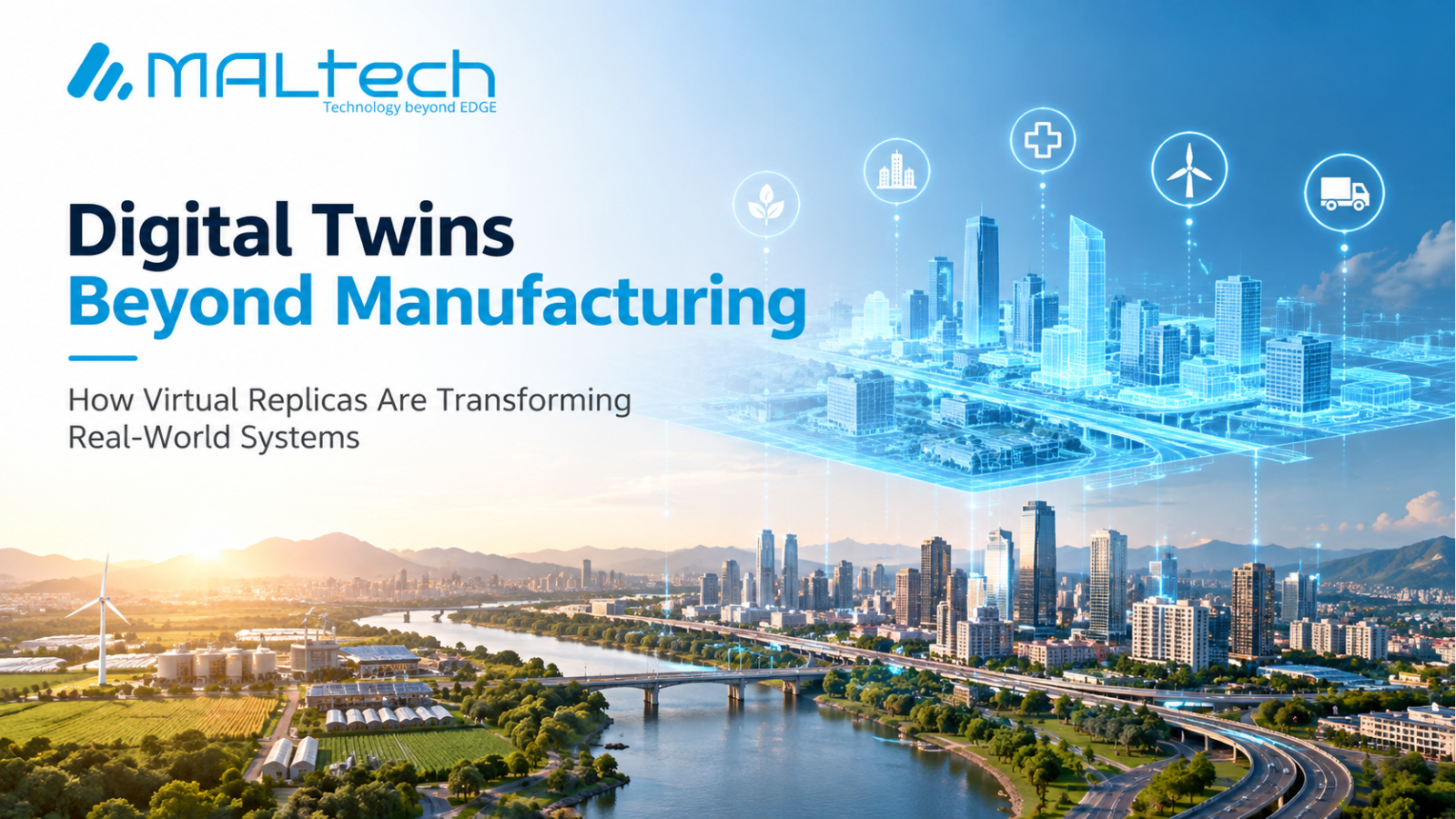
In Smart Cities, digital twins can combine information from traffic systems, public transportation, buildings, utilities, and environmental sensors. City planners can use these models to understand traffic patterns or explore the potential impact of infrastructure changes before implementing them.
In Buildings and real estate, digital twins can connect information from HVAC systems, lighting, security, occupancy, and energy infrastructure. This can help building operators identify unusual energy consumption, monitor equipment, and improve operational efficiency.
Agriculture is another growing area of interest. Soil conditions, weather, temperature, humidity, irrigation, and crop information can be combined to create a digital representation of an agricultural environment. Instead of examining each measurement separately, organizations can use the combined data to understand changing conditions and evaluate possible actions.
In Healthcare, digital twins can be used for applications such as medical equipment monitoring, hospital operations, and process optimization. Researchers are also exploring patient-specific digital models, although this area requires careful consideration of privacy, security, clinical validation, and regulation.
Digital twins can also support energy and transportation systems. Power infrastructure, renewable energy systems, vehicles, warehouses, ports, and logistics networks can be represented digitally to help organizations monitor operations, test scenarios, and plan maintenance.
The industries may be different, but the underlying principle remains the same: use real-world data to create a continuously informed digital representation that can support better decisions.
The Role of Artificial Intelligence
Artificial intelligence makes digital twins significantly more useful.
A digital twin provides the context and representation of a physical system. AI can analyze the data associated with that system and identify patterns that may not be immediately visible.
For example, machine learning can identify unusual equipment behavior and help predict potential failures. In buildings, AI can analyze energy consumption patterns and identify opportunities for optimization. In transportation, it can analyze traffic and operational data to support better planning.
This changes the role of the digital twin from simply answering:
“What is happening?”
to helping answer:
“What is likely to happen next?”
and potentially:
“What should we do about it?”
This progression—from monitoring to prediction and decision support—is one of the most important developments in digital twin technology.
Digital Twins, 3D Models, and Simulations
Digital twins are sometimes confused with 3D models and simulations, but they are not interchangeable.
A 3D model focuses mainly on representing the structure or appearance of an object or environment. A simulation uses computational models to explore how a system could behave under specific conditions.
A digital twin connects a digital representation to a physical counterpart and uses real-world data to keep that representation updated. These technologies can work together. A digital twin may use a 3D model for visualization and simulation tools to test different scenarios. AI can then analyze real-world and simulated data to provide additional insights. The defining feature of a digital twin is the ongoing connection with the physical system.
What Makes a Digital Twin Work?
A digital twin depends on several technologies working together. Sensors and connected devices collect information from the physical environment. Communication networks transfer the data to platforms where it can be stored and processed. The digital twin uses that information to represent the current state of the physical system.
AI, analytics, and simulation can then operate on top of the twin to identify patterns, predict changes, or evaluate possible scenarios. The resulting information can be delivered through dashboards, applications, or automated systems. This creates a continuous relationship between the physical and digital environments: Physical World → Data → Digital Twin → Intelligence → Decision
The quality of the digital twin depends heavily on the quality of the data behind it. If the information is incomplete, inaccurate, or delayed, the digital representation may not accurately reflect reality.
Challenges Organizations Need to Consider
Building a digital twin is more complicated than simply creating a digital model.
Data quality is a major concern. Organizations need reliable and timely information from sensors, systems, and other sources.
Integration can also be difficult because businesses often rely on different databases, applications, APIs, sensors, and legacy systems. Bringing these sources together requires strong architecture and interoperability.
Security and privacy are equally important. A digital twin may contain detailed information about physical infrastructure, equipment, people, or operational processes. Protecting that information is essential, particularly when the system is connected to real-world operations.
Another challenge is model accuracy. A digital twin should not be considered a perfect copy of reality. Physical systems are complex, and models always have limitations. Continuous validation is necessary to ensure that the twin remains useful.
Organizations also need a clear purpose. Building a digital twin simply because the technology is available can create unnecessary complexity. The starting point should be a real operational problem that the technology can help solve.
Where Digital Twins Are Heading
The future of digital twins will be closely connected with AI, IoT, cloud computing, simulation, and automation. As these technologies mature, digital twins can move beyond monitoring and become increasingly capable of evaluating scenarios and supporting complex decisions.
A building could test different energy strategies digitally before implementing them. A city could evaluate infrastructure changes. A logistics company could examine the impact of different routes. An energy operator could explore possible changes to its network.
The goal is not to replace human decision-making. Instead, digital twins can provide better information and a safer environment for testing possibilities before making changes in the physical world. This is where the technology becomes particularly valuable: the digital environment becomes a place where organizations can understand the present and explore the future.
Conclusion
Digital twins have evolved far beyond their original association with manufacturing. They are increasingly being applied to buildings, cities, agriculture, healthcare, energy, transportation, and other complex environments.
Their value comes from connecting the physical world with a continuously updated digital representation. When that connection is combined with AI, real-time data, analytics, and simulation, organizations can move from simply observing systems to understanding, predicting, and improving them.
The future of digital twins is therefore not just about creating digital copies of physical objects. It is about using those digital counterparts to make complex real-world systems more visible, predictable, and manageable.
Digital twins are no longer just replicas of reality—they are becoming intelligent tools for understanding and improving it.