Introduction
Retrieval-Augmented Generation, commonly known as RAG, has become one of the most practical approaches for giving AI systems access to external knowledge. Instead of relying only on what an AI model learned during training, RAG allows a system to retrieve relevant information from documents, databases, knowledge bases, or other sources and use that information when generating a response. That is a significant improvement. But there is a common misconception: RAG alone isn’t enough to make an AI system reliable, intelligent, or autonomous.
RAG can help an AI find the right information. However, real-world business applications often require much more. They may need to reason about information, remember previous interactions, use external tools, follow business rules, verify results, and know when a human should be involved. This is why RAG alone isn’t enough for many enterprise AI applications.
What Is RAG?
Retrieval-Augmented Generation (RAG) is an approach that combines information retrieval with generative AI. Instead of asking an AI model to answer a question entirely from its internal knowledge, a RAG system first retrieves relevant information from an external source.
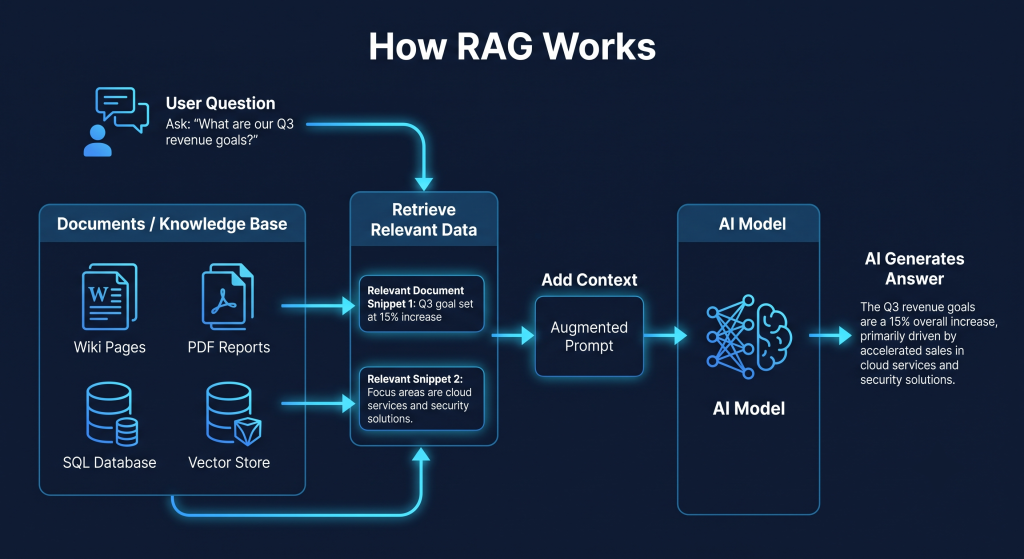
A simplified workflow looks like this: User Question → Retrieve Relevant Information → Add Context → Generate Answer
For example, imagine an employee asks: “What is our company’s leave policy?” A RAG system can search the company’s approved HR documents, retrieve the relevant policy, provide that information to the AI model, and generate an answer based on the retrieved content. This is useful because the AI doesn’t have to rely solely on its general training knowledge.
Why RAG Became So Important
Businesses have large amounts of information stored across documents, knowledge bases, applications, and internal systems. Traditional AI models may not have access to this information. RAG helps bridge that gap. It can allow AI applications to work with:
- Internal documents
- Product documentation
- Company policies
- Knowledge bases
- Technical manuals
- Customer information
- Frequently updated information
For many question-answering and knowledge-retrieval use cases, this can be extremely valuable. But there is an important limitation: Finding information is not the same as solving a problem.
Why RAG Alone Isn’t Enough
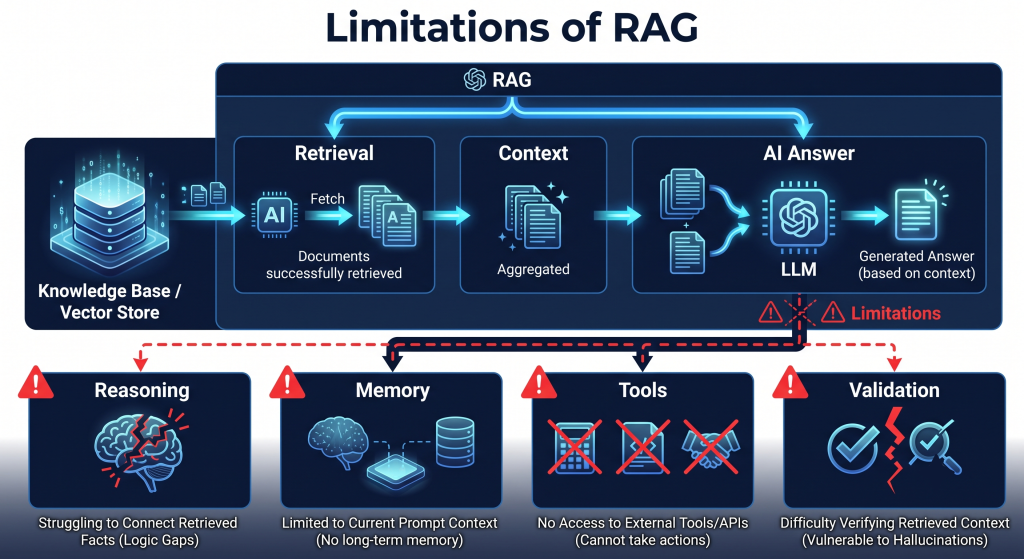
1. Retrieval Does Not Guarantee the Right Context
A RAG system is only as useful as the information it retrieves. If the retrieval system finds irrelevant, incomplete, outdated, or poorly structured information, the AI may generate an answer based on the wrong context. For example, suppose a company has three versions of a policy stored in different locations. An employee asks about the current policy. If the system retrieves an older version, the generated answer may sound perfectly reasonable while still being wrong. So the challenge isn’t simply: “Can we retrieve information?” It is: “Can we retrieve the right information at the right time?”
2. RAG Provides Context, Not Reasoning
RAG can provide an AI model with relevant information, but retrieving information doesn’t automatically mean the system can make a good decision. Consider a sales scenario. A system may retrieve:
- Customer history
- Previous interactions
- Purchase information
- Product details
But the business may still need the AI to determine: What should happen next? That requires reasoning over the available information. RAG can provide the context. The system still needs an appropriate reasoning and decision-making layer.
3. RAG Doesn’t Automatically Take Action
Suppose a customer asks: “My order hasn’t arrived. Can you check what happened?” A RAG system could retrieve the company’s shipping policy and perhaps relevant documentation. But solving the customer’s problem may require much more: Find the order → Check shipment status → Identify the issue → Decide what to do → Create a support request → Notify the customer Retrieving information is only one part of that workflow. The AI needs access to tools and systems that can actually perform actions.
4. RAG Doesn’t Provide Memory by Itself
Another limitation is memory. Consider a customer who has contacted a company several times. A useful AI assistant may need to understand:
- Previous conversations
- Customer preferences
- Earlier problems
- Actions already taken
- Current status
A standard RAG implementation can retrieve historical information, but retrieval and memory are not necessarily the same thing. A production AI system may need a deliberate memory strategy to determine what information should be retained, retrieved, and used in future interactions.
5. RAG Doesn’t Guarantee Accuracy
This is one of the most important points. Even when a RAG system retrieves relevant information, the generated answer can still be incorrect. The model may:
- Misinterpret the retrieved information
- Combine information incorrectly
- Ignore an important detail
- Make an unsupported assumption
- Generate an answer that isn’t fully grounded in the source
So simply adding documents to a RAG pipeline does not eliminate hallucinations. Grounding helps reduce the risk. It doesn’t eliminate the need for validation.
6. Enterprise AI Needs More Than Retrieval
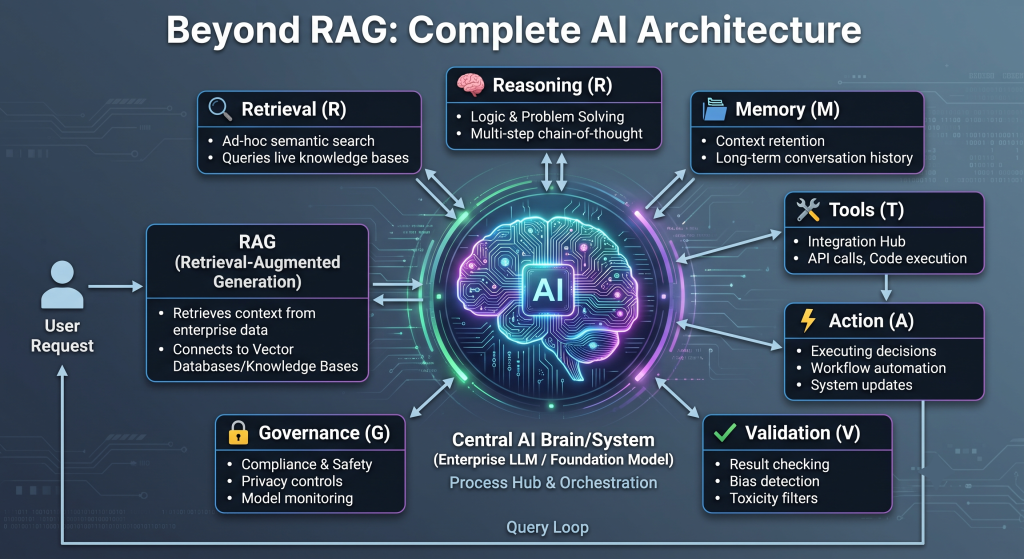
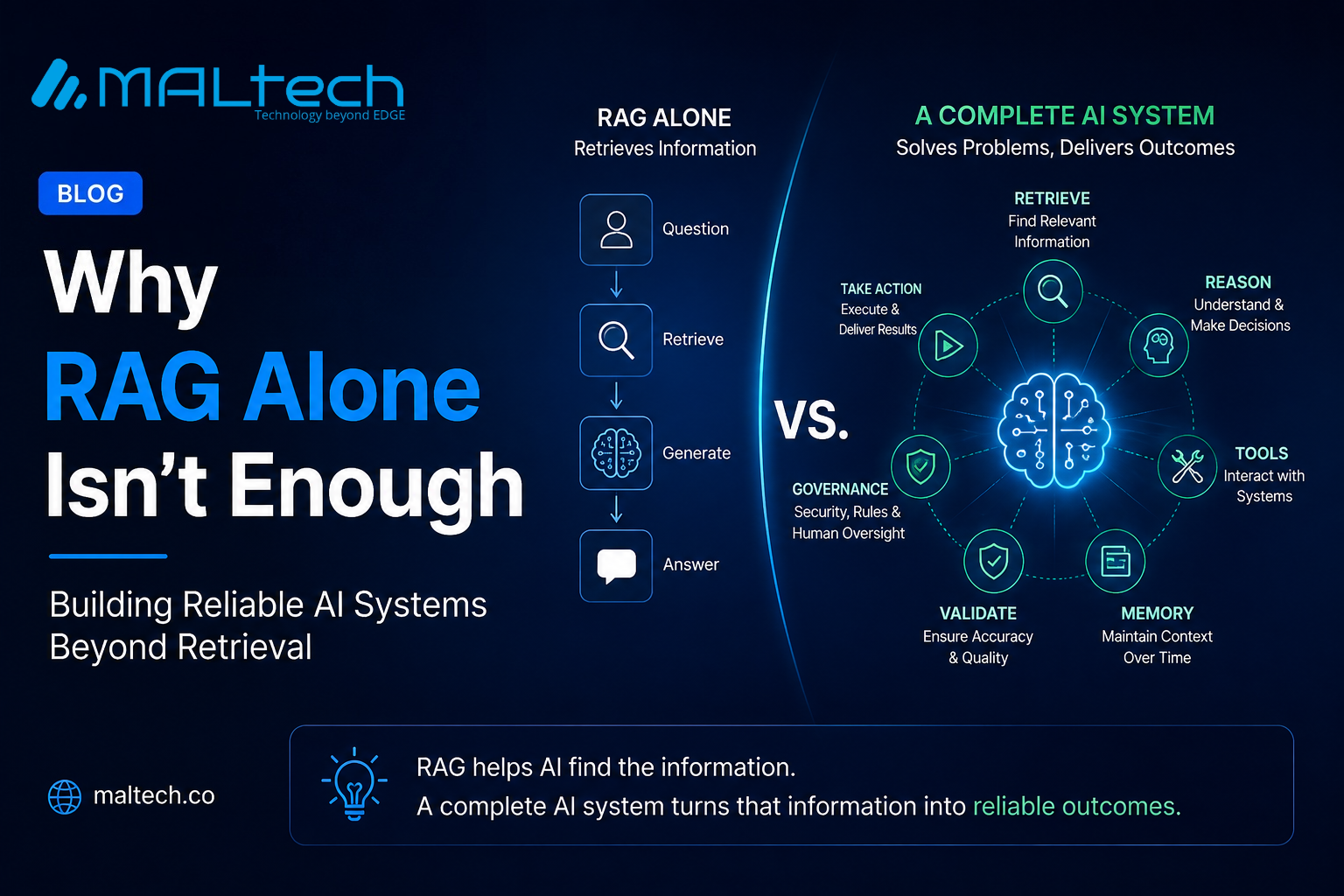
Real business processes rarely depend on one capability. A typical enterprise AI system may need several components working together: Knowledge → Retrieval → Reasoning → Memory → Tools → Validation → Governance. Each component solves a different problem.
Retrieval – Finds relevant information.
Reasoning – Helps the system evaluate information and determine what should happen next.
Memory – Maintains relevant context across interactions.
Tools – Allows the system to interact with external applications and perform actions.
Validation – Checks whether the output or action meets defined requirements.
Governance – Controls access, permissions, security, and human oversight.
RAG can be an important part of this architecture, but it is not the entire architecture.
A Simple Example
Consider an enterprise customer-support system.
RAG-only approach
A customer asks: “Why hasn’t my order arrived?” The system retrieves the company’s shipping policy and generates an answer. It might explain expected delivery timelines. Useful? Yes. But the customer’s actual problem may still be unresolved.
A broader AI system
A more capable system could: Understand the request → Retrieve relevant policies → Access the order system → Check shipment status → Analyze the situation → Decide the appropriate next step → Take action → Inform the customer. Now the system is not simply answering a question. It is solving a business problem. That distinction matters.
RAG vs a Complete AI System
| RAG | Broader AI System |
| Retrieves relevant information | Retrieves and evaluates information |
| Provides context to the model | Uses context for reasoning and decisions |
| Primarily focused on knowledge access | Can support complete workflows |
| Can answer questions using external information | Can interact with tools and systems |
| Helps ground responses | Can validate outputs and actions |
| One component of an architecture | Multiple components working together |
The goal isn’t to replace RAG. The goal is to use RAG where it makes sense and combine it with the other capabilities a business actually needs.
So, What Should Enterprise AI Look Like?
A more complete architecture could look like:
User Request ↓ Understand the Goal ↓ Retrieve Relevant Knowledge ↓ Reason About the Information ↓ Access Tools & Systems ↓ Take Action ↓ Validate the Result ↓ Respond or Escalate
This approach moves beyond simple question answering toward reliable AI workflows. And depending on the use case, not every system needs every component. A simple internal knowledge assistant may only need strong retrieval and generation. A customer-support agent may need retrieval, memory, tools, and validation. A highly autonomous business workflow may require even more controls. The architecture should follow the business problem, not the technology trend.
Where RAG Still Fits
Despite its limitations, RAG remains extremely useful. It is particularly valuable when an AI application needs access to information that is:
- External to the model
- Frequently updated
- Organization-specific
- Large in volume
- Difficult to include directly in prompts
The mistake is not using RAG. The mistake is assuming RAG is the complete solution. RAG should be treated as an important capability within a broader AI architecture.
MALtech Perspective
At MALtech, we see RAG as an important building block for enterprise AI, but not as the final destination. Businesses don’t simply need AI systems that can find information. They need systems that can understand context, reason about problems, interact with business applications, follow rules, and produce reliable outcomes. That means the right architecture may combine RAG with AI agents, memory, tools, validation, security, and governance. The technology should be selected based on the business requirement. Sometimes RAG is enough. Sometimes it is only the beginning. The goal is not to build a bigger RAG pipeline. The goal is to build an AI system that actually solves the problem.
Conclusion
RAG has changed how AI systems can work with external knowledge. It helps connect AI models with information that may not be available within their original training. But enterprise problems are rarely just information problems. They often involve reasoning, memory, tools, decisions, actions, validation, and governance. That’s why RAG alone isn’t enough for many production AI systems. The future isn’t about choosing between RAG and other AI capabilities. It is about combining the right capabilities for the right problem. RAG helps AI find the information.
A complete AI system helps turn that information into reliable outcomes.