
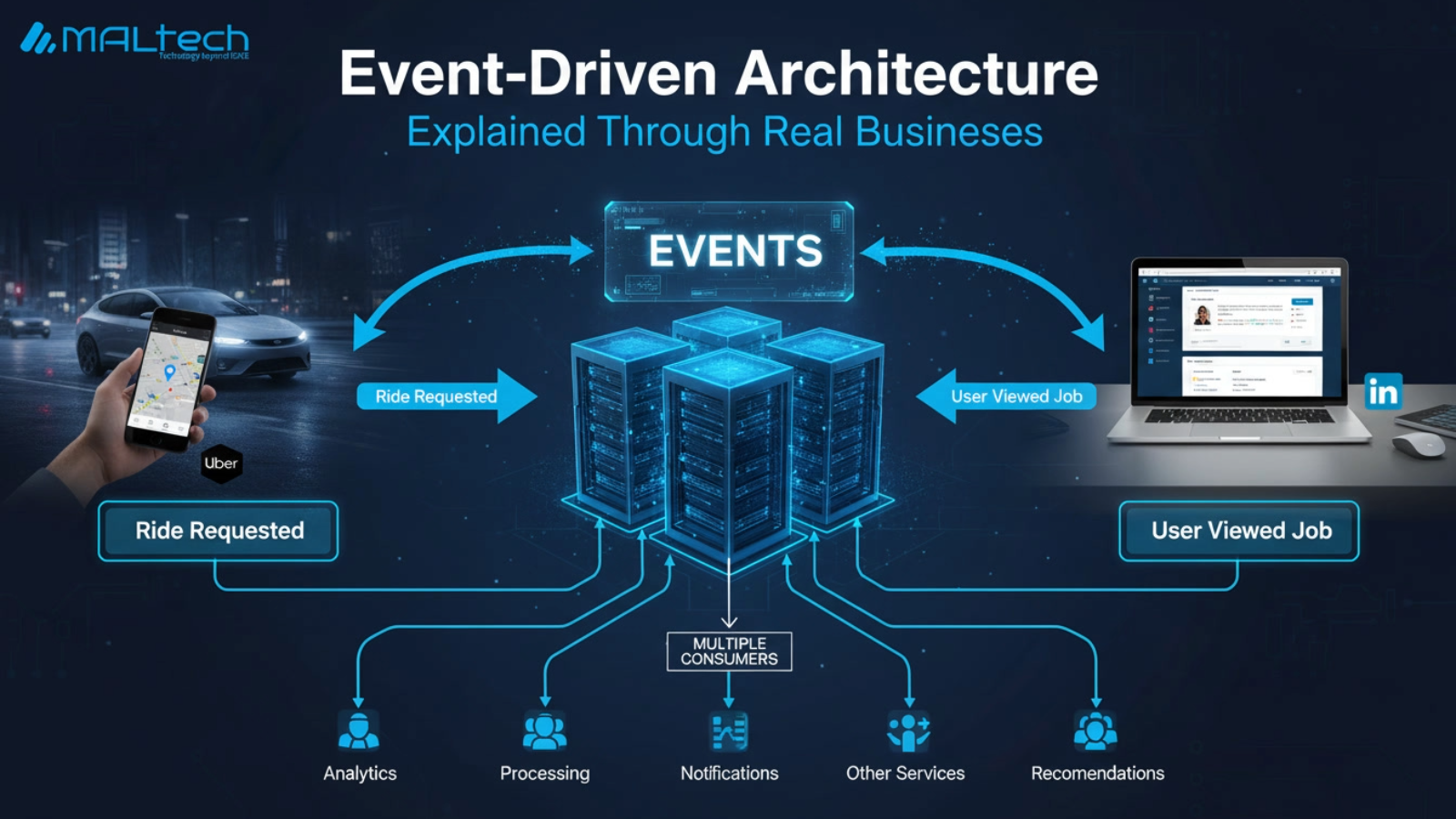
Most people experience event-driven systems without realizing it. You book a ride, place an order, receive a notification, browse a product, or interact with a social platform—and behind that simple action, multiple systems may respond to what just happened.
That is the basic idea behind Event-Driven Architecture (EDA).
Instead of making one system control every step, applications can publish events such as Ride Requested, Order Placed, Payment Completed, or User Viewed Product. Other services can listen for those events and take action independently. The concept sounds simple. At large companies, however, it becomes a powerful way to connect services and process large amounts of real-time information.
Let’s look at two real-world examples.
1. Uber: When a Ride Becomes an Event
Think about what happens when you request a ride. Your request isn’t relevant to just one system. Pricing, driver matching, notifications, trip processing, payments, analytics, and other services may need information about what is happening.
Uber has publicly described Apache Kafka as a major part of its technology infrastructure. Its engineering teams use Kafka as a messaging and data-streaming layer connecting different parts of the platform. Rider and driver application events can flow through Kafka to different downstream consumers for analytics and other processing.
For example: Ride Requested → Event Published → Multiple Services React
The important idea isn’t simply the technology being used. It’s that a business event can become useful to multiple systems without requiring the original service to directly coordinate every downstream action. This approach can help large platforms evolve as new services and capabilities are introduced.
2. LinkedIn: Turning User Activity Into Data
Another example can be seen in large professional networking platforms. When users interact with a platform, activities such as page views, searches, clicks, and other application events can become data streams.
LinkedIn developed Apache Kafka as part of its infrastructure and has described Kafka as a central part of its data and messaging ecosystem. Its engineering teams have used Kafka for activity tracking, analytics, monitoring, messaging, and other distributed-system use cases.
Imagine a simple event: User Viewed Job → Event
That event can be useful to different systems for different purposes, such as analytics, recommendations, monitoring, or other downstream processing. The service generating the event doesn’t necessarily need to know everything that will happen afterward.
That is one of the strengths of event-driven thinking: One Event → Multiple Consumers
What These Examples Have in Common
Although these systems serve different business needs, the underlying challenge is similar:
Something happens—and multiple systems need to know about it.
That’s where event-driven architecture becomes useful. A simplified flow looks like this:
Business Action → Event → Event Platform → Multiple Consumers
For example:
Order Placed
↓
Event Published
↓
Payment | Inventory | Notifications | Analytics | Delivery
Each service can respond according to its own responsibility. This can reduce unnecessary dependencies between services and make it easier to introduce new consumers later.
EDA Is More Than Just Kafka
One important distinction is worth making.
Event-Driven Architecture is an architectural approach. Apache Kafka is one technology that can be used to implement event-driven systems.
Other technologies can also support event-driven architectures, depending on the requirements of the business. The architecture comes first. The technology is selected based on factors such as:
- Scale
- Reliability
- Latency
- Event ordering
- Message retention
- Processing requirements
- Operational needs
Choosing a technology should therefore come after understanding the actual problem the business needs to solve.
When Should a Business Consider EDA?
EDA can be particularly useful when an organization needs to:
- Process events in near real time
- Connect many independent services
- Handle unpredictable traffic
- Support multiple consumers for the same business event
- Reduce tight dependencies between applications
- Build scalable data-processing pipelines
- React quickly to customer or system activity
But EDA isn’t automatically the right answer for every application. Adding event brokers, asynchronous processing, monitoring, schemas, retries, and failure-handling mechanisms also introduces operational complexity. The goal isn’t to make every system event-driven. The goal is to use events where they solve a real business problem.
The Bigger Picture
Event-driven architecture may sound like a purely technical concept, but its real value is business-oriented. Modern digital businesses need systems that can respond quickly when something changes.
An order is placed, payment is completed, customer interacts with an application, transaction is processed. Each of these actions can become an event that other systems can respond to independently. Different businesses may have different requirements and different implementations, but the underlying principle remains the same:
When something important happens, let the systems that care about it respond.
That is the idea behind Event-Driven Architecture. As businesses become more distributed, real-time, and connected, designing systems around events can help organizations build applications that are more responsive and easier to extend.
MALtech — Technology beyond EDGE


