Introduction
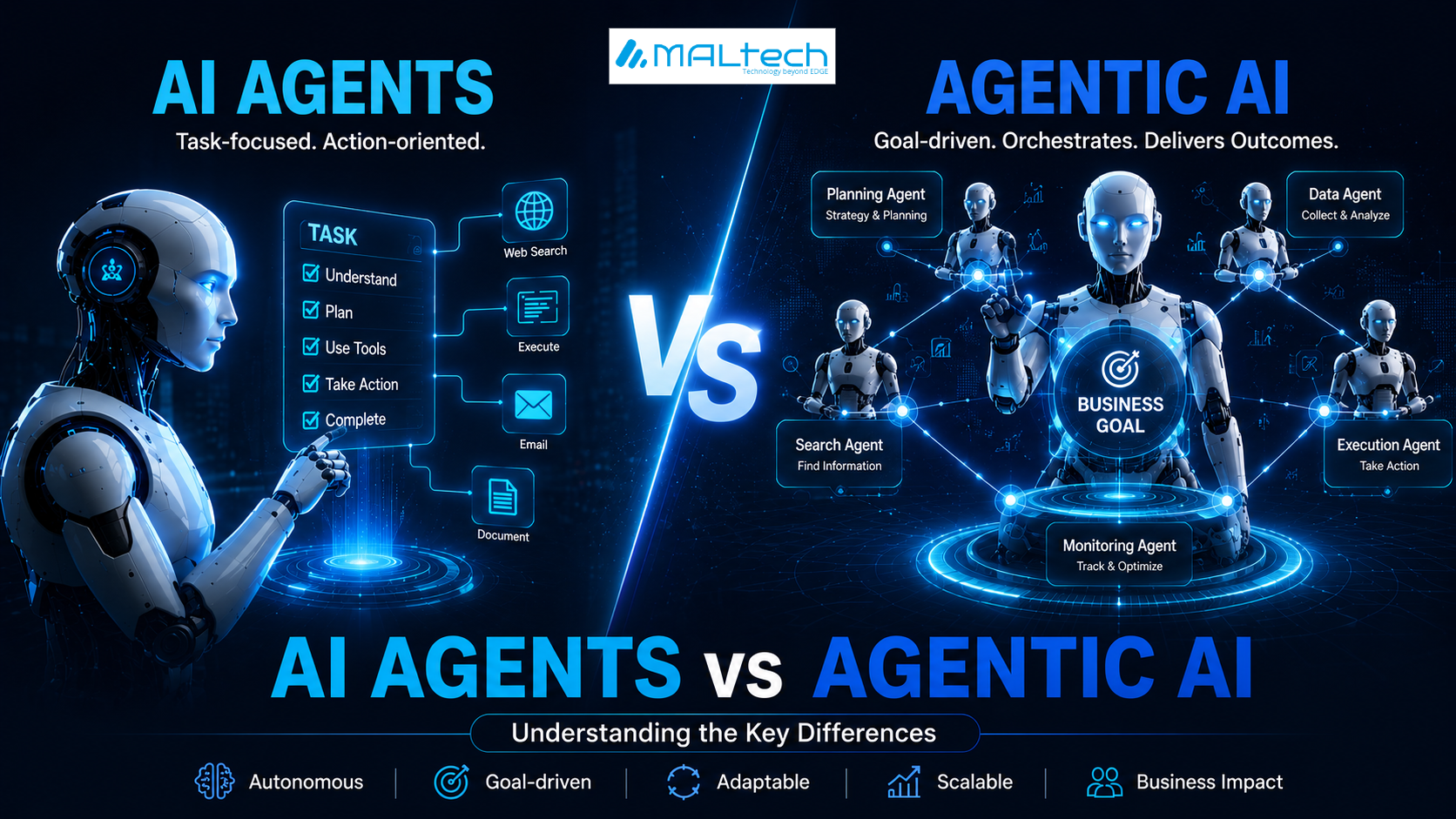
AI Agents vs Agentic AI is becoming an important distinction as businesses move beyond traditional automation. While AI Agents are designed to perform specific tasks using tools and workflows, Agentic AI focuses on broader goals, making decisions, planning actions, and adapting to changing situations.
Two commonly used terms in relation to AI are AI agents and agentic AI. Although they may seem similar, there are some differences between these two. An AI agent is an AI system designed to perform a particular task or workflow. On the other hand, Agentic AI enables systems to pursue a goal, decide what needs to be done, and adapt their actions according to the situation. Understanding AI Agents vs Agentic AI can help businesses choose the right approach to AI adoption.
AI Agents vs Agentic AI: What’s the Difference?
Should you wish to know more about the topic of AI Agents, including their functioning, applications, and the business benefits that can be derived from them, we suggest you check our previously published article entitled AI Agents and the Future of Work
To give you a clear understanding of the distinction, just imagine that the AI Agent is the employee assigned to perform a certain task, whereas Agentic AI is the general term that covers the method by which the AI determines how to reach the objective.
| AI Agents | Agentic AI |
| Performs specific tasks | Moves towards broad goals |
| Frequently functions within a set workflow | Is capable of planning workflows dynamically |
| Utilizes available tools | Capable of determining what tools and actions are necessary |
| May need detailed directions | Needs fewer directions |
| Concerned with task completion | Concerned with goal achievement |
| May function independently | Is capable of coordinating more than one agent or system |
Understanding the Difference
The distinction lies in the scope, decision-making ability, and degree of autonomy involved. An AI Agent can operate autonomously within the specific role assigned to it. Agentic AI refers to the bigger picture whereby AI is able to decide on how to accomplish a task.
A Simple Business Case Study
Consider an example of a customer-support situation. Suppose a customer calls a business due to the failure of his/her order arriving on time.
An AI Agent
The customer-support AI Agent may:
Understand the request → Check the order → Find out information about its delivery → Respond to the customer
This system performs one task within the framework of its capabilities.
Agentic AI
The agentic system would consider this problem differently:
Understand the problem → Investigate the order → Analyze customer’s previous experience → Figure out what is wrong → Decide how to solve the problem → Notify the right system → Inform the customer
The main thing about this process is that it aims at solving the problem rather than executing a certain predefined task. And here is the important difference: AI agents perform tasks. Agentic AI works towards goals.
Why Agentic AI Matters for Businesses
Understanding AI Agents vs Agentic AI helps businesses determine the right approach for different automation and decision-making requirements. Businesses are beginning to move away from task-level automation. Most processes require many interconnected systems, decision-making, and people. For instance, a typical sales process could have the following components:
Leads generation → Leads research → Leads validation → Personal communication → Follow-ups → Lead management
A single AI agent can perform some of the tasks listed above. However, an agentic approach can coordinate these elements and systems according to the overall goal.
Key Benefits of Agentic AI
There are a number of advantages of such an approach.
Increased Efficiency – AI can handle routine tasks, allowing employees to spend more time on creative and strategic work.
Improved Coordination of Workflows – Agentic systems can integrate different applications and AI agents in an overall workflow.
Increased Speed of Decision Making – An AI agent can analyze information and make decisions throughout the workflow process.
Flexibility – In contrast to fixed automation systems, agentic systems can adapt to changes and results of their actions.
However, increased autonomy does not necessarily mean increased efficiency. Businesses should determine the appropriate level of autonomy based on their needs and risks.
Challenges of Agentic AI
At the same time, the move toward more autonomous AI creates additional responsibilities.
Security – Businesses should regulate AI access to applications to minimize unintended actions.
Data Privacy – Companies must safeguard customer and operational data that AI systems can access.
Human Supervision – Humans should still approve significant and high-stakes decisions.
Governance – Companies should set clear limits on AI access, decision-making, and execution.
The objective is not to give AI full control. Instead, companies should aim for responsible autonomy.
MALtech Perspective
At MALtech, we consider the transition from singular AI Agents to more agentic systems a significant milestone in business automation.
Ultimately, the right solution depends on the task.A concentrated AI Agent may do just fine for a specific process, whereas an agentic workflow can be more relevant when it is needed to achieve a bigger purpose using several systems and decisions at once. Our main goal at MALtech is to provide businesses with practical applications of AI.
Conclusion
AI Agents and Agentic AI are related concepts, but they are not identical.
AI Agents are constructed to carry out tasks, utilize tools, and make moves within an assigned domain.
Agentic AI concentrates on more general goal-directed behavior that gives AI systems an ability to plan, decide, adapt, and coordinate moves with more independence.
The easiest way to distinguish between these two concepts is as follows:
AI Agents carry out tasks. Agentic AI achieves goals. As a result, understanding this difference can help companies make better decisions when moving beyond traditional automation. The future of AI does not lie solely in making AI more independent. The future of AI lies in making AI useful and responsible.