AI can answer questions in seconds, summarize long documents, write code, and help employees find information across a business. But there is a problem that becomes much more serious when AI moves from experimentation into real business workflows.
Sometimes, AI gives an answer that sounds completely correct but isn’t. This is known as an AI hallucination.
For a casual chatbot conversation, an incorrect answer might simply be annoying. Inside an enterprise system, the same mistake can affect customers, employees, business decisions, or even automated processes. The challenge is not only getting AI to produce useful answers. It is making sure those answers can be trusted.
What Is an AI Hallucination?
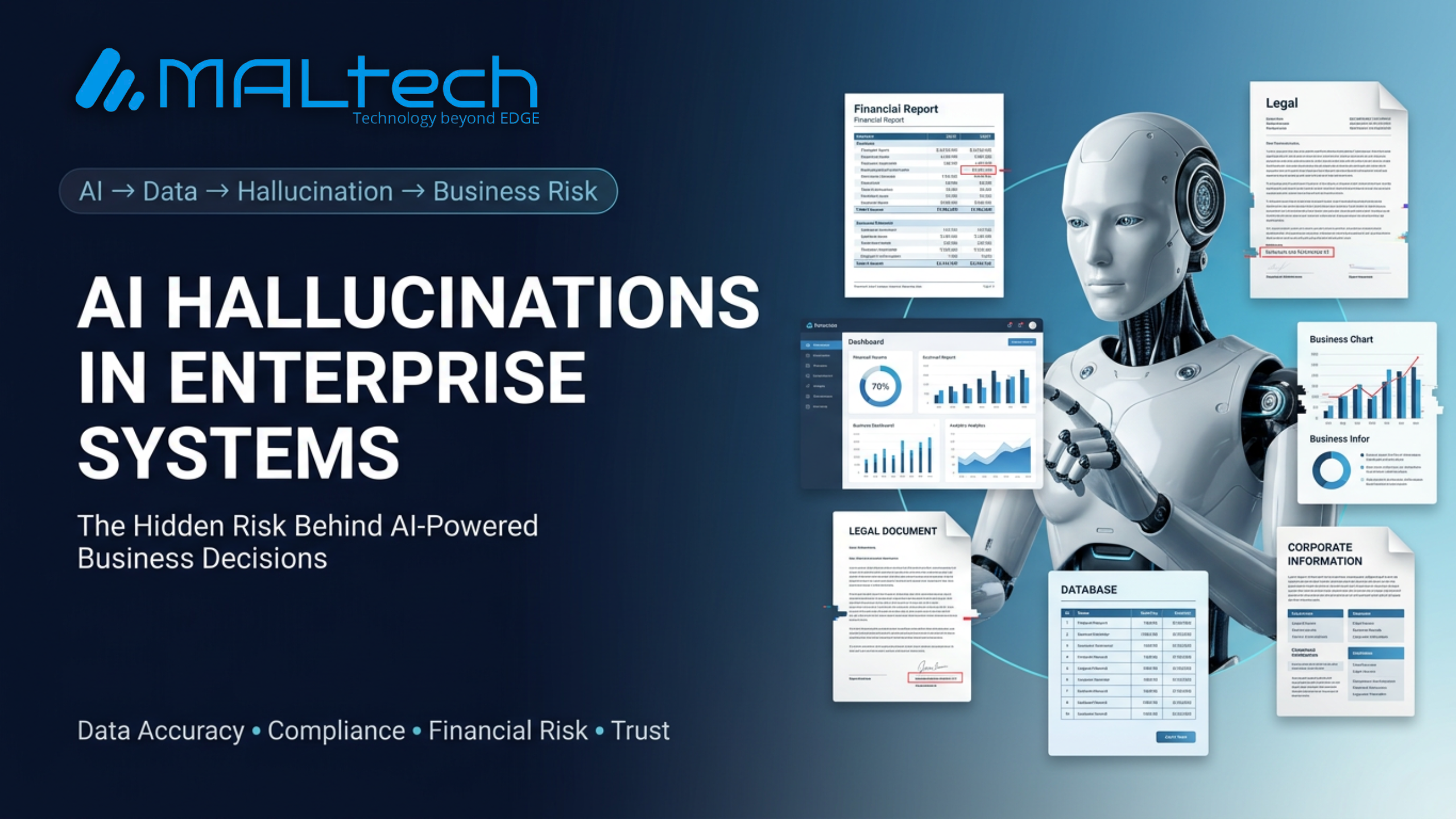
An AI hallucination occurs when an AI system generates information that is unsupported, inaccurate, or fabricated while presenting it as a factual answer.
Consider a simple example. An employee asks an internal AI assistant: “What is our refund policy for enterprise customers?” The system doesn’t have the latest policy document available. Instead of saying that it doesn’t have enough information, it generates a convincing answer based on patterns it has learned.
The response might include a refund period, conditions, or percentages that sound perfectly reasonable. But they may not exist anywhere in the company’s actual policy. That’s what makes hallucinations difficult to spot.
The answer can be wrong without sounding wrong.
Why This Matters More in Enterprise Systems
Enterprise AI doesn’t operate in isolation. It can be connected to customer support platforms, internal knowledge bases, CRM systems, product documentation, databases, development tools, and business workflows.
That means an inaccurate response can travel further than a single chatbot conversation.
For example:
- A support assistant could give a customer incorrect product information.
- An internal assistant could provide an outdated company policy.
- A coding assistant could suggest an API that doesn’t exist.
- An AI reporting system could present incorrect information as a business insight.
- An automated workflow could act on information that was never actually verified.
The risk increases when AI-generated information is automatically passed to another system or used to make decisions. So the question businesses need to ask isn’t simply: “Can AI answer this question?” It is: “Where did the answer come from, and can we verify it?”
Why Do AI Hallucinations Happen?
There isn’t one single reason.
1. The Model Doesn’t Have the Required Information
An AI model cannot reliably answer questions about information it doesn’t have access to. If an employee asks about an internal document that was never provided to the system, the model may try to construct an answer instead of acknowledging the gap.
2. The Question Is Ambiguous
A question can have multiple interpretations. If the system doesn’t have enough context, it may make assumptions about what the user meant.
3. Information Changes
Enterprise information is constantly updated. Product specifications change. Policies change. APIs change. Pricing changes. An answer that was correct months ago may no longer be correct today.
4. Retrieval Doesn’t Work Properly
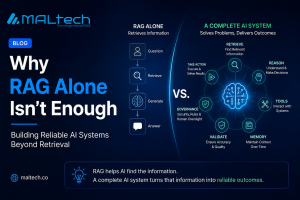
Many enterprise AI systems use Retrieval-Augmented Generation (RAG) to provide models with information from company documents. But retrieval can fail. The system may retrieve the wrong document, miss the relevant section, or provide incomplete context to the model. When that happens, the model is still generating an answer based on limited information.
5. Fluent Answers Create False Confidence
AI models are designed to generate natural language. They can produce responses that are clear, structured, and professional—even when the underlying information is incorrect. This creates an important distinction: A well-written answer isn’t necessarily a verified answer.
Does RAG Solve Hallucinations?
RAG can significantly reduce hallucinations by giving an AI model access to relevant information from trusted sources.
A simplified RAG workflow looks like this: User Question → Retrieve Information → Provide Context → Generate Answer
For example, instead of asking an AI model to remember a company’s refund policy, a RAG system can retrieve the current policy document and provide the relevant information to the model. That gives the model something concrete to work with. But RAG isn’t a magic solution. If the wrong information is retrieved, the model can still generate a wrong answer. This is why improving enterprise AI reliability requires attention to the whole pipeline, not just the language model.
How Businesses Can Reduce Hallucinations
Businesses can take several practical steps to make AI systems more reliable.
Use Trusted Sources
AI systems should retrieve information from approved, maintained sources whenever possible. If the company’s official documentation says one thing and an outdated document says another, the system needs a way to identify which source should be trusted.
Improve Retrieval
Documents need to be properly organized, indexed, and retrieved. Good retrieval gives the model better context and reduces the chance of generating information from incomplete data.
Provide Sources
For important answers, showing the source behind the response can make verification much easier. Instead of simply saying: “The refund period is 30 days.” The system could point the user to the relevant company policy.
Allow the AI to Say “I Don’t Know”
This is one of the simplest—and most important—controls. If the system doesn’t have enough reliable information, it should be able to say so. A clear “I don’t have enough information to answer that” is better than a confident guess.
Monitor Real-World Responses
AI systems need monitoring after deployment. Businesses can analyze incorrect responses, identify recurring failure patterns, improve their data and retrieval processes, and test the system against known scenarios.
Keep Humans Involved Where Necessary
Not every AI-generated answer should trigger an automated business action. For high-impact processes, human review can provide an important layer of protection.
The Bigger Picture
AI hallucinations aren’t going to disappear simply because businesses use a newer or more capable model. The model is only one part of the system.
The quality of the underlying data matters.
The retrieval process matters.
The instructions given to the model matter.
The validation process matters.
And what happens after the AI produces an answer matters too.
This is particularly important as companies move from using AI as a simple assistant to connecting it with real business systems. The goal isn’t to expect AI to never make a mistake.
The goal is to build systems where mistakes are:
- Less likely to happen
- Easier to detect
- Easier to verify
- Less likely to reach customers or critical workflows
Building AI That Businesses Can Trust
Enterprise AI is moving quickly from experimentation to everyday use. As that happens, accuracy becomes more than a model-performance metric. It becomes part of the overall system design.
A reliable AI system needs more than a powerful model. It needs trusted data, good retrieval, clear boundaries, monitoring, validation, and appropriate human oversight. Because in enterprise environments, the most dangerous AI answer isn’t always the obviously wrong one. It’s the answer that sounds right, gets trusted, and turns out not to be.