Introduction
Artificial intelligence has become one of the most discussed technologies in the business world. From customer support and marketing to finance and operations, businesses are exploring ways to use AI to improve productivity, reduce costs, and deliver better services. At the same time, automation continues to play an important role in helping organizations complete routine tasks faster and more consistently.
However, the growing interest in AI has created a common challenge. Some businesses assume that adopting AI is the next necessary step in their digital transformation, even when their existing problems could be solved with simpler automation.
The reality is that AI and automation serve different purposes. Choosing between them requires an understanding of the business problem, the nature of the task, and the outcome an organization wants to achieve. The most effective solution is not always the most advanced technology. It is the one that addresses the problem reliably and delivers measurable value.
Understanding the Difference Between AI and Automation
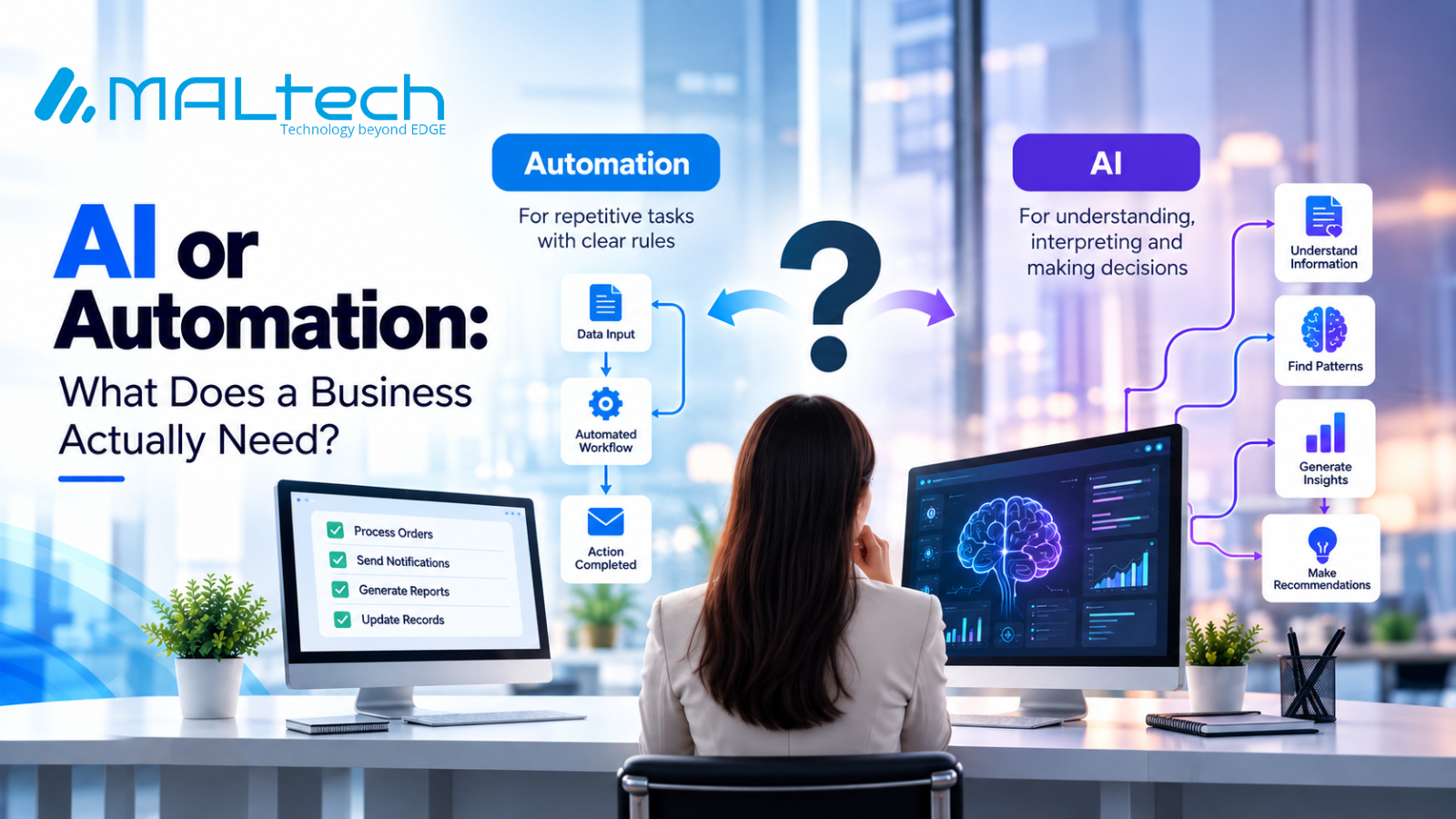
Automation uses predefined rules, workflows, and triggers to execute tasks with minimal manual intervention. When a particular condition is met, the system performs an expected action. Because the process follows established instructions, it is especially useful for repetitive and predictable work.
Consider an online business that sends an order confirmation after a customer completes a purchase. Once the payment is successfully processed, the system automatically sends an email containing the order details. The process follows a defined sequence and does not need to interpret the customer’s intentions or generate a decision from complex information. This is a straightforward example of automation.
Artificial intelligence, on the other hand, enables systems to perform tasks that may involve learning patterns from data, interpreting language, recognizing images, making predictions, or generating content. Depending on the application, an AI system can work with information that is more complex or less predictable than a traditional rule-based workflow.
For example, a customer may send a message explaining a delivery problem in their own words. An AI system can interpret the message, identify the customer’s concern, and classify the request as a delivery-related issue. This interpretation can then help the business determine what should happen next.
The distinction is important. Automation executes a defined process, while AI can help interpret information or produce predictions and recommendations. AI systems can also operate within automated workflows, but they may require additional validation, oversight, and safeguards.
When Automation Is All a Business Needs
Many business activities follow predictable patterns. These tasks do not necessarily require a system that learns, interprets, or generates information. They require a process that works consistently and handles exceptions appropriately.
Invoice generation, appointment reminders, payment notifications, employee onboarding steps, scheduled reports, and routine data transfers are common examples. Once the business rules are established, automation can perform these tasks whenever the relevant conditions are met.
Imagine a company that receives hundreds of online orders every day. After a successful payment, the company needs to update the order status, notify the customer, and alert the fulfilment team. A well-designed automated workflow can complete these steps without requiring an employee to process every order manually.
Introducing AI into this process may add unnecessary complexity if all the steps are already known and the information is structured. The business may need to manage additional costs, model behaviour, and testing without receiving a meaningful improvement in the outcome.
Automation is also valuable when consistency and traceability matter. A clearly defined workflow can make it easier to understand why an action occurred, identify where a process failed, and maintain predictable operational behaviour.
This does not mean automation is always simple or inexpensive to implement. Systems still need reliable integrations, access controls, error handling, monitoring, and maintenance. However, when the task is predictable and the rules are clear, conventional automation is often a sensible starting point.
When AI Brings Meaningful Value
Not every business task follows a fixed sequence. Some activities require information to be interpreted before an appropriate action can be selected. This is where AI can provide capabilities beyond traditional rule-based automation.
Customer support is one example. Customers may describe the same problem in many different ways, use informal language, or combine several questions in a single message. A system based entirely on predefined keywords may struggle to classify these requests accurately. AI can help interpret the message, identify its likely intent, and suggest an appropriate response or category.
AI can also help businesses analyze large volumes of information, summarize lengthy documents, identify patterns in customer feedback, forecast demand, and generate initial drafts of marketing content. These applications are useful when the task involves information that would be difficult to process efficiently through fixed rules alone.
Consider a retail business that wants to understand why customers are returning products. Traditional automation can collect return records and generate reports based on predefined categories. AI can potentially analyze customer comments to identify recurring themes, such as incorrect sizing, damaged packaging, or differences between product descriptions and actual items.
The value of AI lies in the additional interpretation it can provide. It does not automatically guarantee accurate conclusions. The quality of the data, the suitability of the model, and the way results are evaluated all influence whether the system delivers useful outcomes.
Businesses should therefore identify a specific need before introducing AI. If employees spend hours reviewing unstructured information, interpreting customer messages, or identifying patterns across large datasets, AI may be worth evaluating. If the task simply involves moving information between two systems according to known rules, automation may be sufficient.
Why AI and Automation Often Work Better Together
AI and automation are not competing technologies in every situation. In many business processes, they complement each other.
AI can interpret information, classify a request, or generate a recommendation. Automation can then execute the predefined steps associated with that result. This combination allows organizations to handle more complex workflows while retaining control over how routine actions are performed.
Consider a customer support workflow. A customer submits a message describing a problem with an order. An AI component interprets the message and identifies the likely issue. Based on the result, an automated workflow assigns the request to the relevant support team, updates the ticketing system, and sends an acknowledgement to the customer.
In this example, AI helps interpret the request, while automation manages the operational steps. The business can also introduce confidence thresholds, human review for uncertain classifications, and rules that prevent sensitive actions from being performed without approval.
A similar approach can be used in invoice processing. AI can extract information from documents that vary in format, while automation validates the extracted fields, records approved information in the accounting system, and routes exceptions to an employee.
The important point is that combining AI and automation requires thoughtful design. The organization must decide which decisions can be handled automatically, which require verification, and what should happen when the AI produces an uncertain or incorrect result. A successful workflow is not simply an AI model connected to an automated process. It is a controlled system in which each component has a clear responsibility.
How Businesses Can Choose the Right Approach
The decision should begin with the business problem rather than the technology.
First, identify the task that needs improvement. Is the organization trying to reduce repetitive manual work, process information more quickly, improve forecasting, or understand customer requests? A clearly defined problem makes it easier to evaluate possible solutions.
Next, examine how predictable the task is. If the inputs, conditions, and expected actions are known, automation may be the most practical option. If the task involves interpreting language, identifying complex patterns, or working with varied information, AI may provide additional value.
Businesses should also consider the consequences of an incorrect result. An error in a routine notification may be easy to correct, while an incorrect financial decision or an inappropriate response to a sensitive customer issue may have greater consequences. Higher-risk applications need stronger validation, human oversight, and clearly defined limits.
Cost is another important factor. The evaluation should include more than the initial implementation. Data preparation, integration, licensing, monitoring, employee training, security, and ongoing maintenance can all affect the total cost of ownership.
Finally, define how success will be measured. Depending on the use case, relevant measures may include processing time, error rates, operating costs, customer satisfaction, employee workload, or the percentage of tasks completed without manual intervention.
A small pilot can help determine whether the proposed solution improves these measures before the organization expands it. This approach reduces the risk of investing in technology that looks promising but does not address a meaningful business need.
Conclusion
AI and automation both have an important place in modern business, but they solve different kinds of problems. Automation is effective when tasks follow predictable rules and require consistent execution. AI becomes valuable when work involves interpreting information, recognizing patterns, generating content, or producing predictions. When these capabilities are combined thoughtfully, businesses can create workflows that are both intelligent and efficient.
The challenge is not deciding which technology is more advanced. It is understanding what the business actually needs.
Before investing in a new AI solution, organizations should examine their processes, identify the source of the problem, evaluate the available options, and measure the expected benefits. Sometimes, a simple automated workflow will deliver the best result. In other situations, AI may provide capabilities that conventional automation cannot easily achieve. And in many cases, a combination of both will be the most practical choice.
The best technology decision starts with the problem, not the trend. Businesses that follow this principle are better positioned to invest wisely, improve their operations, and build solutions that deliver lasting value.