
Introduction
A business rarely runs on a single software system.
A customer might place an order through a website, make a payment through a payment gateway, have their details stored in a CRM, trigger an inventory update, and receive a confirmation email—all within a few seconds.
To the customer, this feels like one simple process. Behind the scenes, however, several different systems may be involved. The problem begins when those systems cannot communicate effectively.
A website may know that an order has been placed, while the inventory system is still waiting for someone to update it. A payment may be completed successfully, but the CRM may not yet have the customer’s latest information. An email may be sent late because another system never received the information it needed.
None of these systems necessarily has to be bad. The real problem is that they are not working together as one connected workflow. As businesses adopt more digital tools, this problem becomes increasingly important. More software can bring more capabilities, but without proper integration, it can also create more manual work, duplicated data, delays, and opportunities for error.
One Customer Action Can Involve Many Systems
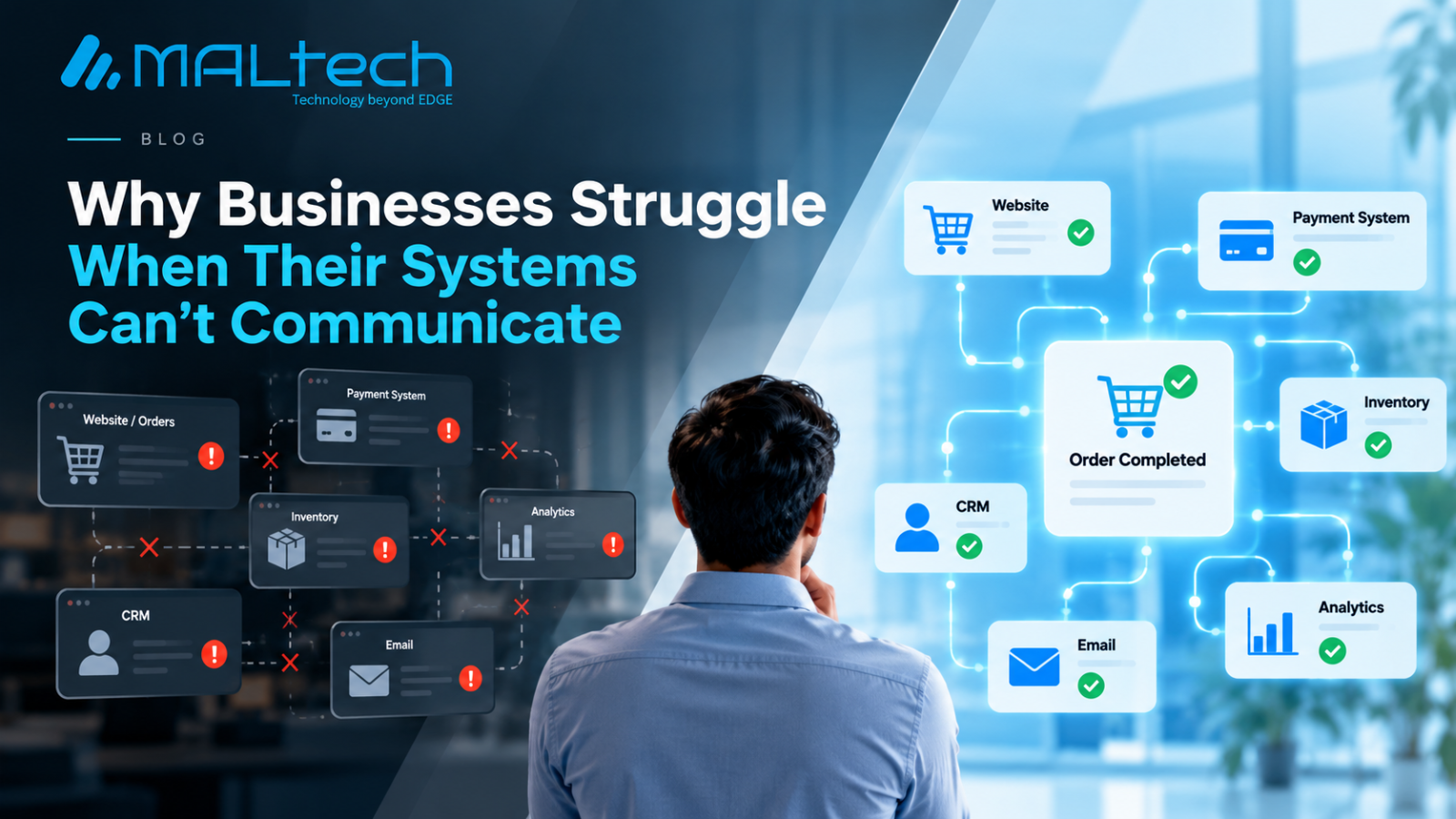
Consider a company that sells products online. When a customer places an order, the website handles the initial transaction. A payment system processes the payment. An inventory system checks and updates stock. A CRM stores customer and order information. An email platform sends the confirmation. An analytics system records the transaction for reporting.
From the customer’s perspective, this is one action: Place an order.
For the business, it can involve several systems working together. Ideally, the process should happen automatically. The customer places an order. The payment is confirmed. Inventory is updated. Customer information reaches the CRM. A confirmation email is triggered. The transaction is recorded for analytics.
The customer does not need to know how many systems are involved because everything behaves like one connected experience. That is what good system integration is supposed to achieve.
What Happens When Systems Don’t Communicate?
Now imagine that these systems are operating independently. The website records the order, but the inventory system does not automatically receive the information. Someone has to check the order, copy the details, open another system, and update the inventory manually. The same information might then need to be entered into the CRM. Another process may be required to send the customer’s confirmation email.
At first, this might seem manageable. If there are only a few orders a day, employees may be able to handle the additional work. But as the business grows, the problem grows with it. Imagine processing hundreds or thousands of transactions. A workflow that requires even a few minutes of manual effort per transaction can quickly become a significant operational burden. More importantly, every additional manual step creates another opportunity for something to go wrong.
The Hidden Cost of Disconnected Systems
The most obvious consequence of disconnected systems is manual work, but the impact goes much further. Employees may spend time moving information between applications instead of focusing on tasks that require human judgment and expertise.
Disconnected systems can also create delays. Information that could have moved between systems instantly may have to wait for someone to notice it and process it.
Then there is duplicate data. The same customer or order information may exist in multiple systems. If one copy is updated and another is not, the business can end up working with conflicting information.
This leads to another major issue: human error. A person entering information manually can accidentally enter the wrong quantity, customer ID, email address, order number, or status. Even a small mistake can affect the next stage of a workflow.
Over time, these small inefficiencies can become expensive. The business may not immediately recognize them as a technology problem because each individual issue seems minor. But when hundreds or thousands of transactions pass through the same disconnected workflow, the accumulated impact becomes difficult to ignore.
When Different Systems Tell Different Stories
One of the more frustrating consequences of poor integration is inconsistent information. Imagine that a customer has successfully completed a payment.
The payment system says: Payment: Successful
But another system still shows: Order: Pending
The customer receives no confirmation and starts wondering whether the order actually went through. From the customer’s point of view, the business appears unreliable. From the company’s point of view, each system may actually be functioning correctly. The payment system processed the transaction. The order system simply never received the updated information. This is an important distinction.
The problem may not be the individual applications. The problem may be the communication between them. That communication layer is what allows separate systems to behave like parts of a single business process.
Where APIs and Integrations Come In
This is where APIs become important. An API, or Application Programming Interface, provides a structured way for software systems to communicate and exchange information.
For example, when a customer completes a payment, the payment system can communicate the result to another application. Instead of an employee checking the payment manually, the system can receive information automatically.
The workflow might look like: Website → Payment System → Inventory → CRM → Email
The systems remain separate, but they can exchange the information required to complete the workflow. This is the real purpose of integration. It is not necessarily about replacing existing software. A business may already have a perfectly good website, CRM, payment platform, inventory system, and email platform.
The goal is to make those systems work together effectively.
Instead of : Person → System → Person → System → Person
the business can move toward: System → Integration → System → Integration → System
That difference can have a significant impact on speed, accuracy, and scalability.
Integration Is More Than Just Connecting Two Applications
It is tempting to think of integration as simply connecting one application to another. In real business environments, it is usually more complicated. A company may have dozens of applications handling different functions. Some may be modern cloud platforms, while others may be older systems that are still critical to daily operations.
Different systems may use different data formats, authentication methods, APIs, and business rules. For integration to work properly, the systems need to exchange the right information at the right time and in the right format. This is why integration is closely connected with areas such as APIs, automation, data transformation, authentication, event-driven architectures, and workflow management. A successful integration does not simply move data. It helps the business process move.
From Connected Systems to Connected Experiences
The biggest benefit of integration is not necessarily technical. It is the experience created for the people using the business. Think about ordering food online. A customer expects the order to move smoothly from placement to payment, restaurant processing, delivery, and status updates.
The customer does not care which application handles each stage. They simply expect the experience to work. Behind that experience, multiple systems may be exchanging information continuously. When those systems communicate properly, the complexity stays in the background. When they do not, the complexity becomes visible to the customer.
A delayed confirmation, incorrect order status, missing update, or repeated request for the same information can make a business feel inefficient—even when the underlying individual systems are technically capable. Good integration essentially hides unnecessary complexity and turns multiple technologies into one connected experience.
Why This Becomes More Important as Businesses Grow
Disconnected systems are often manageable when a business is small. As the business grows, however, the number of customers, transactions, employees, and applications increases. Manual processes that once seemed harmless can become bottlenecks.
For example, manually updating 10 orders may not be a major problem. Doing the same thing for 1,000 orders is very different. This is why integration is closely connected with scalability. A business should not need to increase manual effort at the same rate as transaction volume. Well-designed integrations and automated workflows allow information to move between systems without requiring a person to repeatedly perform the same task.
That does not eliminate the need for people. Instead, it allows people to spend less time transferring information and more time working on tasks where human judgment actually matters.
Building a More Connected Business
There is no single integration strategy that works for every organization. Some businesses may need a simple API connection between two applications. Others may require a broader integration architecture connecting multiple systems, data sources, and workflows.
The right approach depends on the business process, existing technology, data requirements, security considerations, and future scalability needs. The important first step is to understand where information currently gets stuck.
Which processes depend on manual data entry?
Where are employees repeatedly copying information?
Which systems contain conflicting data?
Where do customers experience delays?
Answering these questions often reveals that the biggest problem is not a lack of software, but a lack of connection between the software already being used.
Conclusion
Modern businesses depend on many different digital systems, but customers experience those systems as a single business. That creates a simple expectation: the systems behind the experience need to work together. When they do not, businesses can end up with manual processes, duplicated information, delays, errors, inconsistent data, and frustrated customers.
APIs and integrations provide a way to connect these systems and automate the flow of information between them. But the bigger idea goes beyond technology. Integration is about making business processes work as one connected workflow. The goal is not to have more software. It is to make the software a business already depends on work together more effectively. Because in a connected business, the customer should not have to see the complexity behind the scenes.
They should simply experience a process that works.


